


Page 73 - NS-2 Textbook
P. 73
66                                                                                       MARITIME  HISTORY


             Beginning in 1903, the Navy began building two cap-  the  launching  of  the  first  battleships  of the  27,500-ton
         ital ships (large warships) a yem; a trend that would con-  Queen  Elizabeth class. These developments were soon re-
         tinue for about the next fifteen years, through the Roo-  flected in subsequent warships built by other world-class
         sevelt administration and that of William Howard Taft,   navies, including the United States.
         who succeeded him from 1909 to 1913. The size of these     Advances  also  were being made  in  other fields  of
         ships continually increased, both in displacement and ar-  naval teclmology.  In  1900 Roosevelt urged the Navy to
         mament.  In 1905  Congress  authorized  the  battleships   buy its first submarine, the Hal/and,  named after her in-
         Michigan  and South Cal'Olina,  both of which would have   ventor. Submarines developed rapidly after this, in all of
         eight 12-inch gtms arranged in two pairs of turrets fore   the  world's  major  navies.  Roosevelt  ,\-vas  also  a prime
         and aft.                                               supporter of experin1ents with marmed aircraft, which
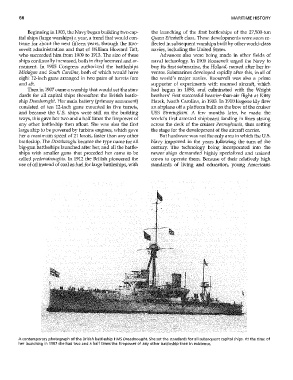
             111en in 1907 catne a warship that would set the stan-  had  beglm  in  1898,  and  culminated  with  the  Wright
         dards for  all capital ships  thereafter:  the  British battle-  brothers' first successful heavier-than-air flight at Kitty
         ship Dreadnought. Her main battery (primary armatnent)   Hawk, North Carolina, in 1903. In 1910 Eugene Ely flew
         consisted  of  ten 12-inch guns mounted in five  turrets,   an airplane off a platform built on the bow of the cruiser
         and  because  the  U.S.  ships  were  still  on  the  building   USS  Birmingham.  A  few  months  latet;  he  made  the
         ways, this gave her two and a half times the firepower of   world's first arrested shipboard lat1ding in lines strung
         any other battleship then afloat.  She was also  the first   across  the deck of the cruiser Pennsylvania,  thus setting
         large ship to be powered by turbine engines, which gave   the stage for the development of the aircraft carrier.
         her a maxinmm speed of 21 knots, faster than at1y other    But hardware was not the only area in which the U.S.
         battleship. The Dreadnought became the type name for all   Navy in1proved in the  years following  the turn of the
         big-gun battleships launched after her, and all the battle-  cenhrry.  The  technology  being  incorporated  into  the
         ships with smaller glms  that preceded her catne  to be   newer ships  demanded highly specialized  at1d  trained
         called predreadnoughts.  In 1912 the British pioneered the   crews  to  operate them.  Because of their relatively high
         use of oil instead of coal as fuel for large battleships, with   standards  of  living  at1d  education,  yotmg  Americat1S


         A contemporary photograph of the British battleship HMS Dreadnought. She set the standards for all subsequent capital ships. At the time of
         her  launching  in  1907 she had two and a half times the firepower of any other battleship then in  existence.

