


Page 71 - NS-2 Textbook
P. 71
64                                                                                       MARITIME HISTORY


         ago  to  capture  the  batteries.  With  naval  assistance,   the blockade weakened, the Spanish admiral chose this
         Shafter landed at Daiquil'i, 16 nllies east of Santiago, on   opportunity to try to escape. He realized his move was
         22 June without opposition.                             an unlikely gamble, but he thought that this was the oniy
             But Shafter had other ideas about how to conduct the   way to avoid slll'render of his squadron without fighting.
         operation.  Instead  of making his objective  the  Spanish   That, he felt, would result in a terrible loss of honor, se-
         batteries, he went charging into the jungle with the intent   verely damage the morale of all Spanish forces, and de-
         of capturing the city. He thought this would either force   stroy Spain's l'eputation in Europe.
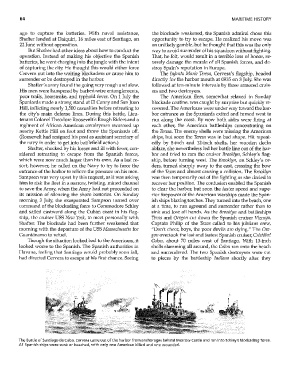
         Cel'vera out into the waiting blockaders or cause him to   The Infanta  Maria  Teresa,  Cervera's flagship, headed
         surrender or be destroyed in the harbor.               directly for the harbor mouth at 0935 on 3 July. She was
             Shafter's army found the going velY rough and slow.   followed at ten-minute intervals by tlll'ee armored cruis-
         His men were hampered by barbed-wire entanglements,    ers and two desh·oyers.
         poor trails, heatstroke, and typhoid fever.  On 1 July the   The  American  fleet,  somewhat  relaxed  in  Slmday
         Spaniards made a strong stand at El Caney and San Juan   blockade routine, was caught by surprise but quickly re-
         Hill, inflicting nearly 1,500 casualties before retreating to   covered. The Americans 'were under 'way tmvard the har-
         the  city's  main defense lines.  During this battle,  Lieu-  bor entrance as the Spaniards exited and turned west to
         tenant Colonel Theodore Roosevelt's Rough Riders and a   run along  the  coast.  By  now both sides were firing  at
         l'egiment of African American cavalrymen swarmed up    each other,  the  American  battleships  concentrating  on
         nearby Kettle Hill on foot and threw the Spaniards off.   the Teresa.  The enemy shells were missing the American
         (Roosevelt had resigned his post as assistant secretary of   ships, but soon the Teresa  was in bad shape. Hit repeat-
         the navy in order to get into battlefield action.)     edly  by  8-inch  and  12-inch  shells,  her  wooden  decks
             Shaftel; shocked by his losses and ill with fever, con-  ablaze, she nevertheless led her battle line out of the har-
         sidered  retreating  to  escape  from  the  Spanish  forces,   bor and tried to ram the cruiser Bl'OoklYIl,  Schley's flag-
         which were now much larger than his own. As a last re-  ship, before turning west. The Bl'Ookly",  on Schley's or-
         sort, however, he called on the Navy to  try to force  the   ders, turned sharply away to the east, crossing the bow
         entrance of the harbor to relieve the pressure on his men.   of the Texas  and almost causing a collision. The Bl'Ooklyll
         Sampson was very upset by fhis request, as it was asking   was then temporarily out of the fighting as she circled to
         him to risk the fleet in a narrow, twisting, mined channel   recover her position. The confusion enabled the Spanish
         to save the Army, when the Army had not proceeded on   to clear the harbOl; but soon the faster speed and supe-
         its mission of silencing the  shore batteries.  On Slmday   rior firepower of the American warships made the Span-
         morning 3 July,  the  exasperated Sampson turned over   ish ships blazing torches. 111ey turned into the beach, one
         command of the blockading force to Commodore Schley    at a  time, to  run aground and surrender rather than to
         and sailed eastward along the Cuban coast in his flag-  sink and lose all hands. As the BrooklY1l  and battleships
         shlp, the cruiser USS New  York,  to meet personally with   Texas  and Oregon  cut down the Spanish cruiser Vizcaya,
         Shafter.  The blockade  had been hll'ther weakened that   Captain Philip  of the  Texas  called  to  his  jubilant crew,
         morning with the departure of the USS Massachusetts for   "Don't cheer, boys, the poor devils are dying." The Ore-
         Guantanamo to refuel.                                  gall overtook the last and fastest Spanish cruiser, Cristobal
             Though the situation looked bad to the Americans, it   COlOIl,  about  70  miles  west  of  Santiago.  With  13-inch
         looked worse to the Spanish. The Spanish authorities in   shells slamming all around, the Cololl ran onto the beach
         Havana, feeling that Santiago would probably soon fall,   and surrendered. 11,e two Spanish destroyers were cut
         had directed Cervera to escape at his first chance. Seeing   to  pieces  by  the  battleship  Indiana  shortly  after  they


         The Battle of Santiago de Cuba. Cervera came out of the harbor from anchorages behind Morrow Castle and ran into Schley's blockading force.
         All  Spanish  ships were sunk  or beached, with  only one American killed and one wounded.

