


Page 137 - Jurnal Kurikulum BPK 2020
P. 137
ELEMENTS OF CURRICULUM AND CURRICULUM DESIGN

                       In  developing  any  curriculum,  questions  of  what  and  how  are  frequently  asked.
               Examples of such questions are: ““What educational purposes should the school seek to attain?
               What educational experiences can be provided that is likely to attain these purposes? How can
               these educational experiences be effectively organised? How can we determine whether these
               purposes are being attained?” (Tyler, 1949, p.1). These questions echoed those asked by Taba
               (1962, p. 425): “What is to be done? What subject matter is to be used? What methods and
               what organisation are to be employed? How are the results going to be appraised?” (Taba, 1962,
               p. 425). Answers to these questions provide input for the formulation of aims and objective,
               subject  content/areas  of  study,  learning  experiences,  and  evaluation  of  learning.  These  are
               known as the elements of curriculum (Beauchamp, 1975; Ornstein & Hunkins, 1993; Taba,
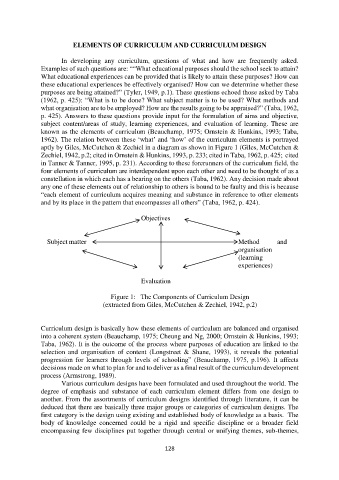
               1962). The relation between these ‘what’ and ‘how’ of the curriculum elements is portrayed
               aptly by Giles, McCutchen & Zechiel in a diagram as shown in Figure 1 (Giles, McCutchen &
               Zechiel, 1942, p.2; cited in Ornstein & Hunkins, 1993, p. 233; cited in Taba, 1962, p. 425;  cited
               in Tanner & Tanner, 1995, p. 231). According to these forerunners of the curriculum field, the
               four elements of curriculum are interdependent upon each other and need to be thought of as a
               constellation in which each has a bearing on the others (Taba, 1962). Any decision made about
               any one of these elements out of relationship to others is bound to be faulty and this is because
               “each element of curriculum acquires meaning and substance in reference to other elements
               and by its place in the pattern that encompasses all others” (Taba, 1962, p. 424).

                                                   Objectives


                  Subject matter                                                     Method       and
                                                                                     organisation
                                                                                     (learning
                                                                                     experiences)

                                                   Evaluation

                                        Figure 1:   The Components of Curriculum Design
                                     (extracted from Giles, McCutchen & Zechiel, 1942, p.2)


               Curriculum design is basically how these elements of curriculum are balanced and organised
               into a coherent system (Beauchamp, 1975; Cheung and Ng, 2000; Ornstein & Hunkins, 1993;
               Taba, 1962). It is the outcome of the process where purposes of education are linked to the
               selection  and  organisation  of  content  (Longstreet  &  Shane,  1993),  it  reveals  the  potential
               progression for learners  through levels  of schooling” (Beauchamp,  1975, p.196).  It affects
               decisions made on what to plan for and to deliver as a final result of the curriculum development
               process (Armstrong, 1989).
                       Various curriculum designs have been formulated and used throughout the world. The
               degree  of  emphasis  and  substance  of  each  curriculum  element  differs  from  one  design  to
               another. From the assortments of curriculum designs identified through literature, it can be
               deduced that there are basically three major groups or categories of curriculum designs. The
               first category is the design using existing and established body of knowledge as a basis.  The
               body  of  knowledge  concerned  could  be  a  rigid  and  specific  discipline  or  a  broader  field
               encompassing few disciplines put together through central or unifying themes, sub-themes,


                                                           128

