


Page 60 - Jurnal Kurikulum BPK 2018
P. 60
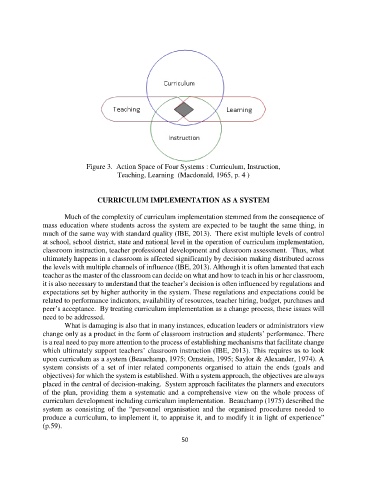
Figure 3.  Action Space of Four Systems : Curriculum, Instruction,
                                        Teaching, Learning  (Macdonald, 1965, p. 4 )


                                 CURRICULUM IMPLEMENTATION AS A SYSTEM

                      Much of the complexity of curriculum implementation stemmed from the consequence of
               mass education where students across the system are expected to be taught the same thing, in
               much of the same way with standard quality (IBE, 2013).  There exist multiple levels of control
               at school, school district, state and national level in the operation of curriculum implementation,
               classroom instruction, teacher professional development and classroom assessment.  Thus, what
               ultimately happens in a classroom is affected significantly by decision making distributed across
               the levels with multiple channels of influence (IBE, 2013). Although it is often lamented that each
               teacher as the master of the classroom can decide on what and how to teach in his or her classroom,
               it is also necessary to understand that the teacher’s decision is often influenced by regulations and
               expectations set by higher authority in the system. These regulations and expectations could be
               related to performance indicators, availability of resources, teacher hiring, budget, purchases and
               peer’s acceptance.  By treating curriculum implementation as a change process, these issues will
               need to be addressed.
                      What is damaging is also that in many instances, education leaders or administrators view
               change only as a product in the form of classroom instruction and students’ performance. There
               is a real need to pay more attention to the process of establishing mechanisms that facilitate change
               which ultimately support teachers’ classroom instruction (IBE, 2013). This requires us to look
               upon curriculum as a system (Beauchamp, 1975; Ornstein, 1995; Saylor & Alexander, 1974). A
               system  consists  of  a  set  of  inter  related  components  organised  to  attain  the  ends  (goals  and
               objectives) for which the system is established. With a system approach, the objectives are always
               placed in the central of decision-making.  System approach facilitates the planners and executors
               of the plan, providing them a systematic and a comprehensive view on the whole process of
               curriculum development including curriculum implementation.  Beauchamp (1975) described the
               system  as  consisting  of  the  “personnel  organisation  and  the  organised  procedures  needed  to
               produce a curriculum, to implement it, to appraise it, and to modify it in light of experience”
               (p.59).


                                                             50

