


Page 55 - Jurnal Kurikulum BPK 2018
P. 55
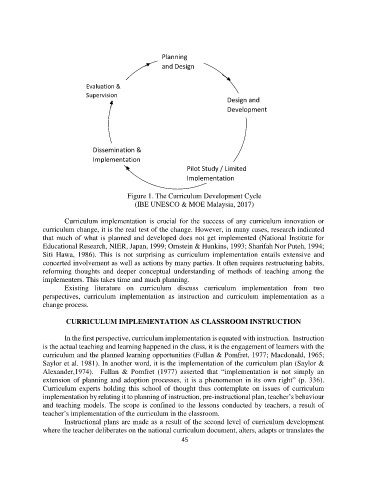
Planning
                                                       and Design


                              Evaluation &
                              Supervision
                                                                            Design and
                                                                            Development


                                Dissemination &

                                Implementation
                                                               Pilot Study / Limited
                                                               Implementation

                                           Figure 1. The Curriculum Development Cycle
                                              (IBE UNESCO & MOE Malaysia, 2017)

                      Curriculum  implementation  is  crucial for the success  of any curriculum innovation  or
               curriculum change, it is the real test of the change. However, in many cases, research indicated
               that much of what is planned and developed does not get implemented (National Institute for
               Educational Research, NIER, Japan, 1999; Ornstein & Hunkins, 1993; Sharifah Nor Puteh, 1994;
               Siti  Hawa,  1986).  This  is  not  surprising  as  curriculum  implementation  entails  extensive  and
               concerted involvement as well as actions by many parties. It often requires restructuring habits,
               reforming  thoughts  and  deeper  conceptual  understanding  of  methods  of  teaching  among  the
               implementers. This takes time and much planning.
                      Existing  literature  on  curriculum  discuss  curriculum  implementation  from  two
               perspectives,  curriculum  implementation  as  instruction  and  curriculum  implementation  as  a
               change process.

                       CURRICULUM IMPLEMENTATION AS CLASSROOM INSTRUCTION

                      In the first perspective, curriculum implementation is equated with instruction.  Instruction
               is the actual teaching and learning happened in the class, it is the engagement of learners with the
               curriculum and the planned learning opportunities (Fullan & Pomfret, 1977; Macdonald, 1965;
               Saylor et al. 1981). In another word, it is the implementation of the curriculum plan (Saylor &
               Alexander,1974).    Fullan  &  Pomfret  (1977)  asserted  that  “implementation  is  not  simply  an
               extension of planning and adoption processes, it is a phenomenon in its own right” (p. 336).
               Curriculum  experts  holding  this  school  of  thought  thus  contemplate  on  issues  of  curriculum
               implementation by relating it to planning of instruction, pre-instructional plan, teacher’s behaviour
               and teaching models. The scope is confined to the lessons conducted by teachers, a result of
               teacher’s implementation of the curriculum in the classroom.
                      Instructional plans are made as a result of the second level of curriculum development
               where the teacher deliberates on the national curriculum document, alters, adapts or translates the

                                                             45

