


Page 56 - Jurnal Kurikulum BPK 2018
P. 56
curriculum intention into classroom activities appropriate to his or her students (Remillard, 1999).
               This  second  level  of  curriculum  development  is  where  teachers  link  their  perception  or
               understanding of the curriculum to their practice, transforming curriculum plan into instruction.
               How is this link being established? What kind of decision and choice teachers need to make at
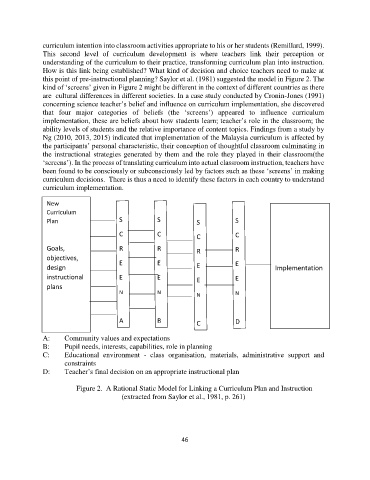
               this point of pre-instructional planning? Saylor et al. (1981) suggested the model in Figure 2. The
               kind of ‘screens’ given in Figure 2 might be different in the context of different countries as there
               are  cultural differences in different societies. In a case study conducted by Cronin-Jones (1991)
               concerning science teacher’s belief and influence on curriculum implementation, she discovered
               that  four  major  categories  of  beliefs  (the  ‘screens’)  appeared  to  influence  curriculum
               implementation, these are beliefs about how students learn; teacher’s role in the classroom; the
               ability levels of students and the relative importance of content topics. Findings from a study by
               Ng (2010, 2013, 2015) indicated that implementation of the Malaysia curriculum is affected by
               the participants’ personal characteristic, their conception of thoughtful classroom culminating in
               the instructional strategies generated by them and the role they played in their classroom(the
               ‘screens’). In the process of translating curriculum into actual classroom instruction, teachers have
               been found to be consciously or subconsciously led by factors such as these ‘screens’ in making
               curriculum decisions.  There is thus a need to identify these factors in each country to understand
               curriculum implementation.

                 New
                 Curriculum
                 Plan                   S            S            S            S

                                        C            C            C            C
                  Goals,                R            R                         R
                  objectives,                                     R
                                        E            E            E            E
                  design                                                                    Implementation
                  instructional         E            E            E            E
                  plans                 N            N
                                                                  N            N


                                        A            B            C            D

               A:     Community values and expectations
               B:     Pupil needs, interests, capabilities, role in planning
               C:     Educational  environment  -  class  organisation,  materials,  administrative  support  and
                      constraints
               D:     Teacher’s final decision on an appropriate instructional plan

                          Figure 2.  A Rational Static Model for Linking a Curriculum Plan and Instruction
                                         (extracted from Saylor et al., 1981, p. 261)


                                                             46

