


Page 111 - fbkCardioDiabetes_2017
P. 111
Cardio Diabetes Medicine 2017                                    87


                                         Peripheral Vascular Disease


                                            Dr. J. Ezhilan, MD, DM, DNB, FNB, FSCAI.
                                              Senior Consultant Interventional Cardiologist
                                                  Madras Medical Mission- Chennai


                 ABSTRACT                                           EPIDEMIOLOGY
                 Peripheral arterial disease (PAD) affects 12% of adult   Peripheral  arterial  disease  (PAD) of  the lower  limbs
                 population and both male and female are equally af-  affects approximately  12% of  the adult population.
                 fected. PAD is always  associated with Coronary  ar-  At younger age, PAD is more prevalent in men than
                 tery  disease  and cerebral  vascular disease  hence it   women; however, with advancing age, gender distri-
                 leads to increase risk of myocardial infarction, stroke   bution  is equal . PAD is always associated with  cor-
                                                                                 1
                 and  death.  Through history taking and  physical ex-  onary  artery  disease  and cerebrovascular  disease
                 amination  complimented by  a array  of non invasive   in 38% of  the population.  Patients with PAD  have a
                 testing can  lead  to early  diagnosis  of PAD which  is   higher rate of all cause mortality and are at increased
                 usually  diagnosed  late or  missed.  Medical  manage-  risk  of  cardio  vascular events, including myocardial
                 ment of  PAD is  primary  risk  factor optimization like     infarction,  stroke  and cardiovascular death. In India,
                 smoking cessation, good control of diabetes mellitus,   around 10 million people are affected with PAD of the
                 optimum blood pressure levels in systemic hyperten-  lower limbs. The 5-year rate of non-fatal cardiovascu-
                 sion and  satin  therapy. For  atypical symptoms and   lar events among patients with symptomatic PAD is
                 mild to moderate claudication  exercise  therapy  and   20% and the mortality ranges from 15 to 30%. Major
                 pharmaco  therapy is sufficient.  For severe claudica-  risk  factors for  PAD are  increasing  age, current or
                 tion, chronic limb ischemia and acute limb ischemia,   past tobacco use, and the presence of diabetes, dys-
                 endovascular  interventions  and  surgical bypass  are   lipidemia,  hypertension  and chronic  kidney  disease.
                 done. The field of interventional cardiology  in PAD   Of these risk factors, smoking and diabetes pose the
                 has been rapidly  expanding in the last decade with   greatest  risk  for  the development and progression
                 a wide array  of new devices that  has made endo-  of PAD.
                 vascular interventions much safer and is now slowly
                 replacing surgical Bypass.                         CLINICAL FEATURES OF PAD

                                                                    A thorough history taking and physical examination
                                                                    is  the first  step  in diagnosing  PAD. Majority  of the
                                                                    patients (30 to 50%) with PAD are asymptomatic and
                                                                    although  patients do not have symptoms  with their
                                                                    activities  of daily living, they may have  functional
                                                                    impairment of formal testing. Atypical symptoms  of
                                                                    PAD include lower  extremity discomfort or fatigue
                                                                    that  begins  during  exertion  but is  not reproducible
                                                                    with  the same level  of exertion and may require  a
                                                                    longer  period  of time to resolve.  Claudication,  the
                                                                    classical  symptom of  PAD  includes pain,  discom-
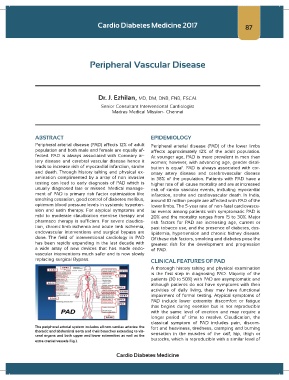
                 The peripheral arterial system includes all non-cardiac arteries: the   fort and heaviness, tiredness, cramping and burning
                 thoracic and abdominal aorta and their branches extending to vis-  sensation in the muscles of the calf,  hip, thigh  or
                 ceral organs  and  both upper and  lower extremities  as well  as the
                 extra cranial vessels Fig.1.                       buttocks, which is reproducible with a similar level of


                                                    Cardio Diabetes Medicine

