


Page 114 - fbkCardioDiabetes_2017
P. 114
90                             Peripheral Vascular Disease


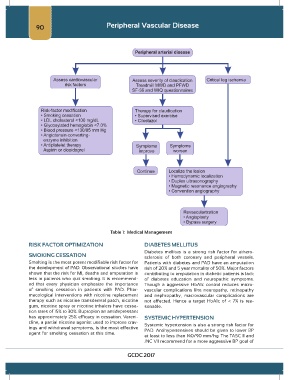
                                                  Table 1:  Medical Management

              RISK FACTOR OPTIMIZATION                           DIABETES MELLITUS
                                                                 Diabetes mellitus is a strong risk  factor  for athero-
              SMOKING CESSATION                                  sclerosis  of  both coronary  and peripheral  vessels.
              Smoking is the most potent modifiable risk factor for   Patients with diabetes and PAD have an amputation
              the development of PAD. Observational studies have   risk of 20% and 5 year mortality of 50%. Major factors
              shown that the risk for MI, deaths and amputation is   contributing to amputation in diabetic patients is lack
              less in patients who quit smoking. It is recommend-  of diabetes education  and  neuropathic  symptoms.
              ed that  every  physician emphasize the importance   Though a  aggressive  HbA1c  control reduces  micro-
              of smoking cessation in patients with  PAD. Phar-  vascular  complications  like  neuropathy,  retinopathy
              macological  interventions  with  nicotine  replacement   and nephropathy, macrovascular  complications  are
              therapy such as nicotine transdermal patch, nicotine   not affected. Hence a target HbA1c of < 7% is  rea-
              gum, nicotine spray or nicotine inhalers have cessa-  sonable.
              tion rates of 15% to 30%. Bupropion an antidepressant
              has approximately 25% efficacy in cessation. Vareni-  SYSTEMIC HYPERTENSION
              cline, a partial nicotine agonist used to improve crav-  Systemic hypertension is also a strong risk factor for
              ings and withdrawal symptoms, is the most effective   PAD. Antihypertensives should be given to lower BP
              agent for smoking cessation at this time.
                                                                 at least to less than 140/90 mm/hg. The TASC II and
                                                                 JNC VII recommend for a more aggressive BP goal of


                                                         GCDC 2017

