


Page 116 - fbkCardioDiabetes_2017
P. 116
92                             Peripheral Vascular Disease


              effects of cilastazol are headache diarrhea, dizziness
              and palpitation. It should be taken 30 minutes before
              or 2 hours after a meal. Cilastazole is contraindicat-
              ed  in systolic  dysfunction  and heart failure  of any
              severity .
                     4
              PENTOXIFYLLINE: a methylxanthine derivative is ap-
              proved by FDA for treatment of claudication however
              it is less effective than Cilastazol. The possible mech-
              anism of action include antiplatelet effects, lowering
              of plasma fibrinogen and improving the deformity of
              red  blood  cells  and white blood  cells.  It gives  a 12%
              improvement n maximal treadmill  walking  distance.
              ACC/AHA  guidelines  recommend  its usage as a
              second line agent after cilastazol  if it fails  or  is  not
              tolerated.
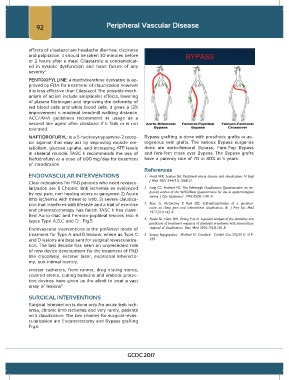
              NAFTIDROFURYL: is a 5-hydroxytryptamine-2 recep-   Bypass grafting is done with prosthetic grafts or au-
              tor agonist that  may act  by improving  muscle me-  togenous vein grafts.  The various Bypass  surgeries
              tabolism, glucose uptake, and increasing ATP levels   done are  aorto-femoral  Bypass,  Fem-Pop  Bypass
              in skeletal  muscle. TASC  II  recommends the use  of   and fem-fem cross  over  Bypass.  The Bypass  grafts
              Naftidrofuryl at a dose of 600 mg/day for treatment   have a patency rate of 70 to 80% at 5 years.
              of claudication.
                                                                 References
              ENDOVASCULAR INTERVENTIONS                         1.  Hiatt WR. Sealove BA, Peripheral artery disease and claudication. N Engl

              Clear indications for PAD patients who need revascu-  J Med 2001:344(21):1068-21.
              larization  are 1)  Chronic  limb ischemia  as evidenced   2.  Leng GC, Fowkers FG. The Edinburgh Claudication Questionnaire: an im-
              by rest pain, non healing ulcers or gangrene. 2) Acute   proved version of the WHO/Rose Questionnaire for use in epidemiological
              limb ischemia with threat to limb. 3) severe claudica-  survey. J Clin Epidemio1 1992;45(0):1101-9.
              tion that interferes with lifestyle and a trial of exercise   3.  Rose  G, McCartney  P, Reid  DD. Self-administration  of a question-
              and pharmacotherapy has failed. TASC II has classi-  naire  on chest  pain  and intermittent  claudication.  Br. J Prev  Soc  Med
                                                                   1977;31(1):42-8.
              fied Aorto-illiac  and  Femoro-popliteal  lesions  into  4
              types Type A,B,C and D : Fig.5                     4.  Pande RL, Hiatt WR, Zhang P, et al. A pooled analysis of the durability and
                                                                   predictors of treatment response of cilostazol in patients with intermittent
              Endovascular interventions is the preferred mode of   respond of claudication. Vasc Med 2010;15(3):181-8.
              treatment for Type A and B lesions, where as Type C   5.  Sanjay Rajagopalan,  Michael H. Crawford . Cardiol Clin 29(2011) 319-
              and D lesions are best sent for surgical revasculariza-  329.
              tion. The  last  decade has seen  an unprecedent role
              of new device development for the treatment of PAD
              like  cryoplasty, excimer  laser,  excisional  atherecto-
              my, sub-intimal reentry,

              crosser  catheters,  front runner, drug  eluting stents,
              covered stents, cutting balloons and embolic protec-
              tion devices  have  given  us  the albeit  to treat  a  vast
              array of lesions .
                            5
              SURGICAL INTERVENTIONS
              Surgical Intervention is done only for acute limb isch-
              emia, chronic limb ischemia and very rarely, patients
              with claudication. The two choices for surgical revas-
              cularization are Endarterectomy and Bypass grafting
              Fig.6


                                                         GCDC 2017

