


Page 141 - fbkCardioDiabetes_2017
P. 141
Regression of Atherosclerosis- In Diabetics                               117


                 accurate measurement of fibrous cap thickness and
                 tissue composition, and also for detection of macro-
                 phages that appear as signal-rich bands with a sharp
                 shadow [8].
                 NIRS: This imaging technique shows a high correla-
                 tion with histopathology  for  lipid  detection with a
                 sensitivity  and  specificity  of  90%  [9].  “Chemogram”
                 derived  from NIRS  provides  compositional and no
                 structural information. It  also  provides  automated
                 lipid-core  detection,  thereby facilitating  its real-time
                 use  for  detection of  lipid-rich  lesions  during  cardiac
                 catheterization.  Overall, these modalities each  fea-
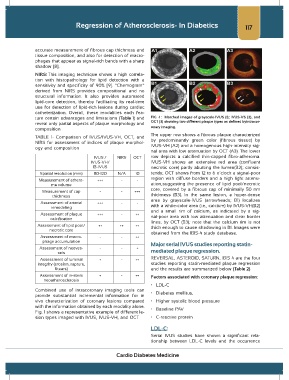
                 ture certain advantages and limitations (Table 1) and   FIG  -1  :  Matched  images  of grayscale-IVUS (1);  IVUS-VS  (2),  and
                 reveal only partial aspects of plaque morphology and   OCT (3) showing two different plaque types as defined byintracor-
                 composition                                        onary imaging.
                                                                    The upper row shows a fibrous plaque characterized
                 TABLE  1- Comparison  of IVUS/IVUS-VH,  OCT,  and   by predominantly green  color (fibrous tissue) by
                 NIRS  for  assessment  of indices of plaque  morphol-  IVUS-VH (A2) and a homogenous high-intensity sig-
                 ogy and composition
                                                                    nal area with low attenuation by OCT (A3). The lower
                                          IVUS /     NIRS   OCT     row  depicts  a calcified thin-capped fibro-atheroma.
                                         IVUS-VH/                   IVUS-VH  shows an extensive  red  area  (confluent
                                          IB-IVUS                   necrotic  core) partly  abutting  the lumen(B2);  consis-
                   Spatial resolution (mm)   80-120  N/A     10     tently, OCT shows from 12 to 6 o’clock a signal-poor
                                                                    region  with  diffuse borders  and a high light attenu-
                  Measurement of athero-    +++       -      -
                        ma volume                                   ation,suggesting  the presence of  lipid  pool/necrotic
                                                                    core, covered by a fibrous  cap of minimally 50 nm
                    Measurement of cap       -        -     +++
                        thickness                                   thickness (B3).  In the same  lesion,  a hyper-dense
                                                                    area by grayscale-IVUS  (arrowheads; B1) localizes
                   Assessment of arterial   +++       -      -      with a white-color area (i.e., calcium) by IVUS-VH(B2)
                       remodeling
                                                                    and a small  rim of  calcium,  as  indicated by  a sig-
                   Assessment of plaque     +++       -      ++     nal-poor  area with  low attenuation  and  clear border
                       calcification
                                                                    lines,  by  OCT (B3);  note that  the calcium  rim  is  not
                  Assessment of lipid pool/  ++       ++     ++     thick enough to cause shadowing in B1. Images were
                       necrotic core
                                                                    obtained from the IBIS-4 study database.
                   Assessment of macro-      -        -      ++
                    phage accumulation                              Major serial IVUS studies reporting statin-
                  Assessment of neoves-      -        -      +
                          sels                                      mediated plaque regression.
                   Assessment of luminal     +        -      ++     REVERSAL, ASTEROID, SATURN, IBIS 4 are the four
                  integrity (erosion, rupture,                      studies  reporting  statin-mediated  plaque  regression
                         &tears)                                    and the results are summarized below (Table 2)
                   Assessment of in-stent    +        -      ++     Factors associated with coronary plaque regression:
                    neoatherosclerosis
                                                                    •  LDL-C
                 Combined use of intracoronary imaging  tools  can   •  Diabetes mellitus,
                 provide  substantial incremental information for  in
                 vivo characterization  of coronary lesions  compared   •  Higher systolic blood pressure
                 with the information obtained by each modality alone.   •  Baseline PAV
                 Fig. 1 shows a representative example of different le-
                 sion types imaged with IVUS, IVUS-VH, and OCT      •  C-reactive protein

                                                                    LDL-C:

                                                                    Serial  IVUS  studies have  shown  a significant  rela-
                                                                    tionship between LDL-C  levels  and the occurrence


                                                    Cardio Diabetes Medicine

