


Page 142 - fbkCardioDiabetes_2017
P. 142
118                          Cardio Diabetes Medicine 2017


               Study     Study Population  Sample    Months Drug &    On Treatment  Median Change of Pav
                                         Size        Dose             LDL-C
               REVERSAL Stable CAD       654         18 mon           2.05         +0.2% (_0.3% to 0.5%),
                                                     Atorvastatin 80               p = 0.18 vs. baseline
               ASTEROID  Stable CAD      349         24 mon Rosuvas-  1.57         -0.79% (-1.21% to 0.53%),
                                                     tatin40                       p <0.001 vs. baseline
               SATURN    Stable CAD      1039        24  mon          1.82         -0.99% (_1.19 to _0.63),
                                                     Atorvastatin 80   1.62        p <0.001 vs. baseline
                                                     Rosuvastatin40                1.22% (_1.52 to _0.90),
                                                                                   p < 0.001 vs. baseline
               IBIS 4    STEMI           103         13 mon Rosuvasta- 1.90        0.90% (_1.56% to - 0.25%),
                                                     tin 40
                                                                                   p 1/4 0.007 vs. baseline
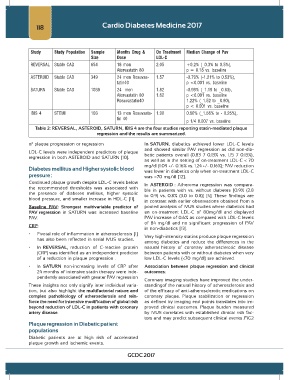
                 Table 2: REVERSAL, ASTEROID, SATURN, IBIS 4 are the four studies reporting statin-mediated plaque
                                            regression and the results are summarized.

              of plaque progression or regression                In SATURN, diabetics achieved lower  LDL-C levels
                                                                 and showed similar  PAV regression  as did non-dia-
              LDL-C levels were independent predictors of plaque
              regression in both ASTEROID and SATURN [10].       betic patients overall  (0.83  7 0.13%  vs. 1.15 7 0.13%),
                                                                 as well as in the setting of on-treatment LDL-C < 70
                                                                 mg/dl (1.09 +/- 0.16% vs. 1.24 +/- 0.16%); PAV reduction
              Diabetes mellitus and Higher systolic blood        was lower in diabetics only when on-treatment LDL-C
              pressure :                                         was >70 mg/dl [12].
              Continued plaque growth despite LDL-C levels below   In  ASTEROID  : Atheroma regression  was compara-
              the  recommended thresholds was associated with    ble  in patients with  vs. without  diabetes  [0.9%  (2.8
              the presence  of diabetes  mellitus, higher  systolic   to 0.9)  vs. 0.8% (3.0  to 0.8)] [4].  These  findings  are
              blood pressure, and smaller increase in HDL-C [11].
                                                                 in contrast with earlier observations obtained from a
              Baseline  PAV: Strongest multivariable  predictor of   pooled analysis of IVUS studies where diabetics had
              PAV regression  in SATURN  was  increased  baseline   an on-treatment LDL-C  of 80mg/dl and displayed
              PAV.                                               PAV increase of 0.6% as compared with LDL-C levels
                                                                 of 84  mg/dl  and  no significant  progression  of PAV
              CRP:
                                                                 in non-diabetics [13].
              •   Pivotal role of inflammation in atherosclerosis [1]   Very high-intensity statins produce plaque regression
                 has also been reflected in serial IVUS studies.
                                                                 among diabetics and  reduce the  differences  in the
              •   In REVERSAL,  reduction of  C-reactive protein   natural  history of coronary atherosclerotic disease
                 (CRP) was identified as an independent predictor   between patients with or without diabetes when very
                 of a reduction in plaque progression .          low LDL-C levels (<70 mg/dl) are achieved.
              •   In  SATURN non-increasing levels  of CRP after   Association  between  plaque regression  and clinical
                 24 months of intensive statin therapy were inde-  outcomes:
                 pendently associated with greater PAV regression
                                                                 Coronary imaging studies have improved the under-
              These insights not only signify inter individual varia-  standingof the natural history of atherosclerosis and
              tion, but also  highlight  the multifactorial nature and   of the efficacy of anti-atherosclerotic medications on
              complex pathobiology  of atherosclerosis  and  rein-  coronary  plaque. Plaque  stabilization or  regression
              force the need for intensive modification of global risk   as defined by imaging end points translates into im-
              beyond reduction of LDL-C in patients with coronary   proved  clinical  outcomes. Plaque  burden measured
              artery disease.                                    by IVUS correlates with established clinical risk fac-
                                                                 tors and may predict subsequent clinical events .FiG2
              Plaque regression in Diabetic patient
              populations
              Diabetic  patients are  at high  risk  of accelerated
              plaque growth and ischemic events.

                                                         GCDC 2017

