


Page 203 - fbkCardioDiabetes_2017
P. 203
Clinical Presentation and Management                                      179
                                               of Acute Heart Failure


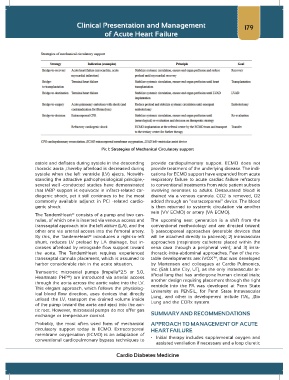
                                              Pic 1: Strategies of Mechanical Circulatory support


                 astole and deflates during systole in the descending   provide  cardiopulmonary support.  ECMO does  not
                 thoracic aorta ,thereby afterload is decreased during   provide treatment of the underlying disease. The indi-
                 systole  when  the left ventricle (LV) ejects. Notwith-  cations for ECMO support have expanded from acute
                 standing the attractive pathophysiological principle,-  respiratory  failure to acute  cardiac  failure refractory
                 several  well  -conducted  studies  have demonstrated   to conventional treatments from wide patient subsets
                 that IABP support is equivocal in infarct-related car-  involving neonates  to adults.  Desaturated  blood is
                 diogenic shock, yet it still continues to be the most   drained  via a venous cannula.  CO2 is  removed,  O2
                 commonly  available adjunct  in PCI -related  cardio-  added through an “extracorporeal” device. The blood
                 genic shock.                                       is  then returned to systemic circulation  via another
                                                                    vein (VV ECMO) or artery (VA ECMO).
                 The TandemHeart® consists of a pump and two can-
                 nulas, of which one is inserted via venous access and   The upcoming  next  generation  is a shift  from the
                 transseptal approach into the left atrium (LA), and the   conventional  methodology  and are  directed  toward:
                 other one via arterial access into the femoral artery.   1) paracorporeal approaches (wearable  devices  that
                 By  this, the  TandemHeart® introduces  a right-to-left   will be attached directly to patients); 2) intravascular
                 shunt,  reduces  LV  preload  by  LA  drainage,  but in-  approaches  (respiratory  catheters  placed within  the
                 creases afterload by retrograde flow support toward   vena cava  through a peripheral  vein);  and 3)  intra-
                 the aorta. The  TandemHeart  requires  experienced   thoracic-intra-abdominal approaches. Few of the no-
                 transseptal cannula placement, which is assumed to   table developments are: iVOX™, that was developed
                 harbor considerable risk in the acute situation.   by  Mortensen  and colleagues  at Cardio  Pulmonics,
                                                                    Inc. (Salt Lake City, UT), as the only intravascular ar-
                 Transaortic microaxial  pumps  (Impella®2.5  or  5.0,   tificial lung that has undergone human clinical trials;
                 Heartmate PHP®) are introduced  via arterial  access   another design requiring placement through the right
                 through the aorta across the aortic valve into the LV.   ventricle into the PA was developed  at Penn State
                 This elegant approach, which follows the physiolog-  University  as PENSIL,  for Penn  State Intravascular
                 ical blood  flow direction, uses  devices  that  directly   Lung,  and other  in  development  include ITAL  ,Bio
                 unload  the LV, transport the drained volume inside   Lung and the CORx system.
                 of the pump toward the aorta and eject into the aor-
                 tic root. However, microaxial pumps do not offer gas
                 exchange or temperature control.                   SUMMARY AND RECOMMENDATIONS
                 Probably, the  most often  used form of mechanical  APPROACH TO MANAGEMENT OF ACUTE
                 circulatory support  today is  ECMO. Extracorporeal   HEART FAILURE
                 membrane oxygenation (ECMO)  is  an adaptation  of   •  Initial therapy  includes supplemental oxygen  and
                 conventional cardiopulmonary bypass techniques to
                                                                      assisted ventilation if necessary and a loop diuretic

                                                    Cardio Diabetes Medicine

