


Page 206 - fbkCardioDiabetes_2017
P. 206
Non-Infarct Related Artery Intervention  in St-Elevation Myocardial Infarc-
                 182               tion With Multivessel Disease: MultiVessel PCI in STEMI:
                                                       Timing of Intervention?


              bypass grafting, and a 40% decrease in MACEs with multivessel revascularization compared to culprit only
              revascularisation [4]. But the timing multivessel PCI is variable from during index PCI to upto 60 days after
              discharge. Another mata-analysis by Vlaar PJ et al[5] have defined 3 approaches for non-culprit intervention
              in MVD-STEMI patients; aggressive approach (multivessel PCI at the time of index procedure), intermediate
              approach (staged PCI during index hospital stay or within 30days  of index procedure) or conservative  ap-
              proach (non-culprit intervention only in case of refractory symptoms or objective evidence of ischaemia). This
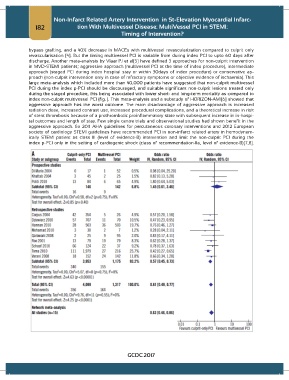
              large meta-analysis which included more than 40,000 patients have suggested that non-culprit multivessel
              PCI during the index p-PCI  should be discouraged, and suitable significant  non-culprit lesions  treated only
              during the staged procedure, this being associated with lower short- and long-term mortality as compared to
              index non-culprit multivessel PCI (fig. ). This meta-analysis and a substudy of HORIZON-AMI[6] showed that
              aggressive  approach  has the worst  outcome.  The  main  disadvantage of  aggressive  approach  is  increased
              radiation dose, increased contrast use, increased procedural complications, and a theoretical increase in risk
              of stent thrombosis because of a prothrombotic proinflammatory state with subsequent increase in in-hospi-
              tal outcomes and length of stay. Few single centre trials and observational studies had shown benefit in the
              aggressive approach. So  2011 AHA  guidelines  for  percutaneous  coronary interventions and 2012  European
              society of cardiology STEMI guidelines have recommended PCI in non-infarct related artery in hemodynam-
              ically  STEMI  patient as  class  III  (level  of  evidence-B) intervention and  limit the non-culprit PCI  during  the
              index p-PCI only in the setting of cardiogenic shock (class of recommendation-IIa, level of evidence-B)[7,8].


                                                         GCDC 2017

