


Page 205 - fbkCardioDiabetes_2017
P. 205
Cardio Diabetes Medicine 2017                                    181


                                Non-Infarct Related Artery Intervention in

                 St-Elevation Myocardial Infarction With Multivessel Disease:
                         MultiVessel PCI in STEMI - Timing of Intervention?


                                       Dr. Shirish Hiremath, MD. DM(Card). MNAMS. FISE

                                         Director, Cath Lab  Ruby Hall,  President  CSI 2016-2017
                                              Managing Trustee  & Chairman  AIMS, Pune


                 Approach to Multivessel disease in STEMI: Perfect Is The Enemy of Good!
                 For patients presenting with ST-elevation myocardial infarction (STEMI), primary angioplasty (pPCI) of the cul-
                 prit vessel, is the treatment of choice [1, 2]. Recent advances in PCI techniques, hardware and antithrombotic
                 therapy alongwith reduced transportation time have led to significantly reduced mortality in pPCI. But 40-
                 60% patients with STEMI have multivessel disease (MVD) at the time of presentation. In STEMI, presence of
                 multivessel disease is associated with poor outcome compared to single vessel disease, including a need for
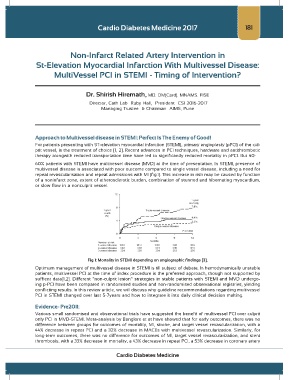
                 repeat revascularisation and repeat admissions with MI (fig.1). This increase in risk may be caused by function
                 of a noninfarct zone, extent of atherosclerotic burden, combination of stunned and hibernating myocardium,
                 or slow flow in a nonculprit vessel.


                                        Fig 1: Mortality in STEMI depending on angiographic findings [3].
                 Optimum management of multivessel disease in STEMI is till subject of debate. In hemodynamically unstable
                 patients, multivessel PCI at the time of index procedure is the preferred approach, though not supported by
                 suffient data[1,2]. Different “non-culprit lesion” strategies in stable patients with STEMI and MVD undergo-
                 ing p-PCI have been compared in randomised studies and non-randomised observational registries, yielding
                 conflicting results. In this review article, we will discuss why guideline recommendations regarding multivessel
                 PCI in STEMI changed over last 5-7years and how to integrate it into daily clinical decision making.

                 Evidence- Pre2011:

                 Various small randomised and observational trials have suggested the benefit of multivessel PCI over culprit
                 only PCI in MVD-STEMI. Meta-analysis by Banglore et at have showed that for early outcomes, there was no
                 difference between groups for outcomes of mortality, MI, stroke, and target vessel revascularization, with a
                 44% decrease in repeat PCI and a 32% decrease in MACEs with multivessel revascularization. Similarly, for
                 long-term outcomes, there was no difference for outcomes of MI, target vessel revascularization, and stent
                 thrombosis, with a 33% decrease in mortality, a 43% decrease in repeat PCI, a 53% decrease in coronary artery


                                                    Cardio Diabetes Medicine

