


Page 225 - fbkCardioDiabetes_2017
P. 225
Alcohol Heart, Diabetes and Lipids                                  201


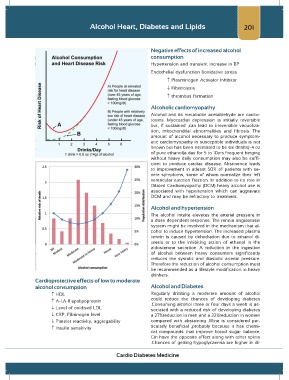
                                                                    Negative effects of increased alcohol
                                                                    consumption
                                                                    Hypertension and transient increase in BP
                                                                    Endothelial dysfunction &oxidative stress
                                                                           ↑ Plasminogen Activator Inhibitor

                                                                           ↓ Fibrinolysis
                                                                           ↑ thrombus formation

                                                                    Alcoholic cardiomyopathy
                                                                    Alcohol and its  metabolite acetaldehyde are  cardio-
                                                                    toxins.  Myocardial  depression is  initially  reversible
                                                                    but,  if sustained ,can  lead to irreversible  vacuoliza-
                                                                    tion,  mitochondrial  abnormalities  and  fibrosis.  The
                                                                    amount  of alcohol  necessary  to produce symptom-
                                                                    atic cardiomyopathy in susceptible individuals is not
                                                                    known but has been estimated to be six drinks(~4 oz
                                                                    of pure ethanol)a day for 5 to 10yrs.Frequent binging
                                                                    without heavy daily consumption may also be suffi-
                                                                    cient to produce  cardiac disease.  Abstinence leads
                                                                    to improvement in atleast  50%  of patients with  se-
                                                                    vere  symptoms, some of whom  normalize their left
                                                                    ventricular ejection fraction. In addition to its  role  in
                                                                    Dilated Cardiomyopathy (DCM) heavy alcohol use is
                                                                    associated with hypertension which  can aggravate
                                                                    DCM and may be refractory to treatment.

                                                                    Alcohol and hypertension
                                                                    The  alcohol intake elevates  the arterial  pressure  in
                                                                    a dose dependent response. The rennin angiotensin
                                                                    system might be involved in the mechanism that al-
                                                                    cohol to induce hypertension. The increased plasma
                                                                    rennin is caused  by dehydration due to ethanol  di-
                                                                    uresis  or to the  inhibiting  action  of ethanol  in the
                                                                    aldosterone  secretion. A reduction  in the ingestion
                                                                    of alcohol  between heavy consumers significantly
                                                                    reduces  the systolic  and diastolic arterial  pressure.
                                                                    Therefore the reduction of alcohol consumption must
                                                                    be recommended as a lifestyle modification in heavy
                                                                    drinkers.
                 Cardioprotective effects of low to moderate
                 alcohol consumption                                Alcohol and Diabetes
                        ↑ HDL                                       Regularly  drinking  a moderate amount  of alcohol
                                                                    could  reduce the  chances  of developing  diabetes
                        ↑ A-I,A-II apolipoprotein
                                                                    .Consuming alcohol three or four days a week is as-
                        ↓ Level of oxidised LDL                     sociated with a reduced risk of developing diabetes
                        ↓ CRP, Fibrinogen level                     a 27%reduction in men and a 32%reduction in women
                        ↓ Platelet reactivity, aggregability        compared with abstaining  .Wine is considered par-
                        ↑ Insulin sensitivity                       ticularly beneficial ,probably because it has chemi-
                                                                    cal  compounds that  improve  blood sugar  balance.
                                                                    Gin have the opposite effect along with other spirits
                                                                    .Chances of getting hypoglycaemia are higher in di-


                                                    Cardio Diabetes Medicine

