


Page 222 - fbkCardioDiabetes_2017
P. 222
198                     Cardio Diabetes Medicine 2017


              by the stimuli of cytokines/ TNFalpha/ Interleukin-1/   The level of hsCRP in all three group of subjects with
              Viral products/ Bacterial component/ yeast products   diabetes was significantly more than  in the  healthy
              can activate  more  than  160 specific  inflammatory.   controls but, patients with Low  bodyweight  Type  2
              and immune target  genes  by  specific  binding with   DM had  significantly lower  levels  of serum hsCRP
              NF-κB  decameric consensus sequences  in DNA  .  A   compared to obese patients with Type 2 DM. In Low
              recent gene profiling study showed that high glucose   bodyweight Type 2 diabetics, values of serum hsCRP
              treatment  of monocytes leads  to increased  expres-  were  found  to have  significant  positive  correlation
              sion of multiple inflammatory cytokines, chemokines   with age and waist hip ratio.
              and related  factors many of which  are  regulated  by   Low bodyweight, standard weight and obese subjects
              pro-inflammatory  transcription factor, nuclear fac-  with diabetes had lower values of serum adiponectin
              tor  Kappa  B  (NF-Κb) synthesis.  Significant  positive   as compared to healthy controls. Reduced adiponec-
              correlation between  NF-κB  expression  in  peripheral   tin levels in patients with Type2 DM is well recognized
              blood  mononuclear cells and HbA 1c  levels has been   in world literature. Statistical significant difference in
              reported previously,     wherein  exposure  to  hy-  the values of adiponectin between Obese Type2DM
              perglycemia  induced  activation  of  the  transcription   and Low Bodyweight  Type2DM subjects ( p  = 0.01)
              factor  NF-kappaB in ex vivo-isolated peripheral  blood   suggest a lesser proinflammatory load in the latter..
              mononuclear  cells  .
                                                                 Lean habitus is mostly due to lack of fat depot and
              The levels of expression of NF-κB in peripheral blood   central  adiposity rather than nutritional  deficiency.
              mononuclear cells were found to be higher in diabet-  The above observation is an expected aberration in
              ic subjects as compared to healthy controls. Interest-  subjects with Low  Bodyweight  Type2  DM and com-
              ingly,  statistical significance  of difference was seen   patible with our earlier observations of low Homocys-
              only between standard  bodyweight  diabetics and   teine, high Glucokinase and brisk hepatic metabolic
              healthy controls  ,  but not between Low bodyweight   state in Low Bodyweight Type2 diabetics (7,8).
              diabetics and  healthy  controls  .  The most revealing ob-
              seravation was that the expression  of  NF-κB  was lowest   The  expression  of  NF-κB  was lowest  in Low  Body-
              in Low  Bodyweight  Type2  diabetics  as  compared  to   weight Type2 diabetics as compared to both standard
              both Group B and C while the  value of optical density   weight and obese. This also indicates that, the lower
              observed  in them was near  similar to  that observed   level of inflammatory stress experienced by subjects
              in healthy  controls (Table 4).                    with Low Body weight type 2 DM as compared to the
                                                                 standard weight and obese diabetics.

                                                                 Conclusion :
                                                                 Observation  of lower  hsCRP,  relatively  lower  levels
                                                                 of adiponectin (probably due to sparse fat pool) and
                                                                 lower expression of NF-κB which is similar to that ob-
                                                                 served in healthy controls, supplement to the already
                                                                 observed lipid profile which is not conducive for ath-
                                                                 erogenesis, and low plasma levels of homocysteine
                                                                 in explaining  the lesser  prevalence  of MVD in Low
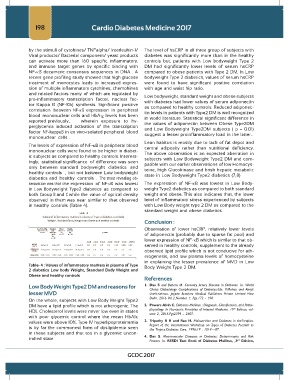
              Table- 4 : Values of inflammatory markers in plasma of Type   Body Weight Type 2 DM.
              2 diabetics Low  body  Weight,  Standard  Body  Weight and
              Obese and healthy controls
                                                                 References
              Low Body Weight Type2 DM and reasons for           1.  Das S  and Behera M. Coronary Artery Disease  in Diabetes.  In. World
                                                                   Clinics  Diabetology  Complications  of Diabetes.Eds.  V.Mohan  and Ranjit
              lesser MVD                                           Unnikrishnan.  Jaypee  Brothers  Medical  Publishers  Private  Limited  New
                                                                   Delhi. 2016 Vol.2,Number 1; Pgs.172 - 190.
              On the whole, subjects with Low Body Weight Type2
              DM have a lipid profile which is not atherogenic. The   2.  Powers Alvin C. Diabetes Mellitus : Diagnosis, Classification, and Patho-
                                                                                                        th
              HDL Cholesterol levels were never low even in states   physiology. In Harrison’s Principles of Internal Medicine. 19  Edition, vol-
                                                                   ume 2, 2015.Pgs2399 – 2407.
              with poor  glycemic control where  the mean HbA1c
              values were above 10%. Type IV hyperlipoproteinemia   3.  Tripathy B B and Rao H. Malnutrition and Diabetes  in theTtropics.
              is  by  far  the commonest  form  of  dyslipidemia  seen   Report of  the International Workshop on Types of  Diabetes Peculiar to
                                                                   the Tropics.Diabetes Care, 1996;19 : 1014—07.
              in these subjects and that too in a glycemic uncon-
              trolled state.                                     4.  Das S. Macrovascular  Diseases  in  Diabetes:  Determinants  and Risk
                                                                   Factors. In.  RSSDI Text Book of Diabetes  Mellitus, ,3  Edition,
                                                                                                          rd

                                                         GCDC 2017

