


Page 220 - fbkCardioDiabetes_2017
P. 220
196                     Cardio Diabetes Medicine 2017


                                                                 our recent studies assessing the clinical, biochemical
                               Lean Type 2 DM
                                                                 profile  as well as autoimmune  status  and  state of
                                Cuttack Jaipur     Madras
                                                                 insulin resistance has also revealed  that  Low Body
                                               Male   Female     Weight Type  2 diabetics had lower  cholesterol  visa
               Hypertension       8.8    14.5    -       -       vis raised Tg and normal HDLc levels as depicted in
               CAD                8.8    9.1    18.9    21.0     Table 2. On the whole, Low Body weight Type 2 DM
                                                                 have a favourable lipid profile that could be a conse-
               PVD                5.5    7.5    5.2     7.0
                                                                 quence of hepatic handling of HDL and CHO metab-
               Peripheral        49.5   23.3   44.6     38.6     olism and lack of hyperinsulinemia-insulin resistance
               neuropathy
                                                                 in the peripheral bed.(R 7,8)
               Nephropathy        6.6    9.1    4.7     4.4
                                                                 Plasma levels of homocysteine is an acknowledged
               Retinopathy       19.8    16.9   37.3    33.3
                                                                 independent marker/risk  factor of macrovascular
               Tuberculosis       7.7    9.6     -       -       disease.  On evaluation  of plasma  levels  of homo-
               Other infections  28.6     -      -       -       cysteine in subjects with Typ2 DM, it was found that
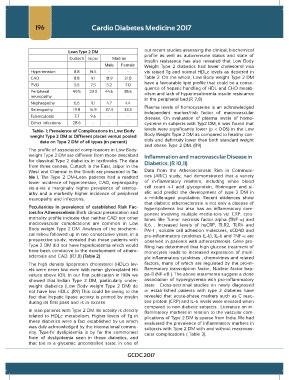
               Table- 1: Prevalence of Complications in Low Body   levels were significantly lower (p < 0.05) in the Low
              weight Type 2 DM at Different places versus pooled   Body Weight Type 2 DM as compared to healthy con-
                   data on Type 2 DM of all types (in percent)   trols and definitely lower than both standard weight
                                                                 and obese Type 2 DM. (R9)
              The profile of associated complications in Low Body-
              weight Type 2 DM are different from those described   Inflammation and macrovascular Disease in
              for classical Type 2 diabetics in textbooks. The data   Diabetics. (R 10,11)
              from three centres, Cuttack in the East, Jaipur in the
              West and Chennai in the South are presented in Ta-  Data  from the Atherosclerosis  Risk in Communi-
              ble 1. The Type  2 DM-Lean  patients had a marked   ties (ARIC)  study, had  demonstrated that  a variety
              lower  incidence of hypertension, CAD,  nephropathy   of  in-flammatory  markers,  including white blood
              vis-a-vis  a marginally  higher  prevalence  of  retinop-  cell count  α-1 acid glycoprotein,  fibrinogen  and si-
              athy  and  a markedly  higher incidence  of peripheral   alic acid predict  the development of type  2 DM in
              neuropathy and infections.                         a middle-aged population. Recent  evidences show
                                                                 that diabetic atherosclerosis is not only a disease of
              Peculiarities  in prevalence  of established  Risk  Fac-  hyperlipidemia  but  also has an inflammatory  com-
              tors for Atheroscelosis :Both clinical presentation and   ponent involving multiple media-tors viz.  CRP,  cyto-
              mortality  profile  indicate that neither  CAD nor  other   kines  like  Tumor  necrosis  factor alpha (TNF-α) and
              macrovascular  complications  are common  in Low   IL6. . Increased  levels  of hsCRP, TLR2, TLR4 and
              Body  weight Type  2 DM. Analyses  of the biochemi-  PAI-1  , soluble  cell adhesion molecules, sCD40  and
              cal milieu followed up in two consecutive years, in a   pro-inflammatory cytokines IL-1β, IL-6 and TNF-α are
              prospective  study, revealed  that  those patients with   observed in patients with atherosclerosis. Gene pro-
              Type 2 DM did not have hyperlipidemia which would   filing has determined that high glucose treatment of
              have been conducive to the development of athero-  monocytes leads  to increased  expression  of  multi-
              sclerosis and CAD. (R7,8) (Table 2)                ple inflammatory cytokines , chemokines and related
              The high density lipoprotein  cholesterol  (HDLc)  lev-  factors,  many  of which  are regulated by the  pro-in-
              els were never low even with mean glycosylated Hb   flammatory transcription  factor, Nuclear  factor kap-
              values above 10%. In our first publication in 1984 we   pa-B (NF-κB ). The above statements suggest a close
              showed that  Indian  Type  2 DM,  particularly under-  association  of hyperglycemia  with  pro-inflammatory
              weight diabetics (Low Body weight Type  2 DM)  do   state .  Cross-sectional  studies  on newly  diagnosed
              not have low HDLc .(R9) This could be owing to the   or  estab-lished patients with  type  2 diabetes have
              fact that  hepatic lipase  activity is  primed  by  insulin   revealed  that  acute-phase  markers  such  as C reac-
              during its first pass and is in excess             tive protein (CRP) and IL-6 levels were elevated when
                                                                 compared to non-diabetic subjects . Literature on in-
              in lean patients with Type 2 DM. Its activity is directly   flammatory markers in relation to the vascular com-
              related  to HDLc  metabolism.  Higher  levels  of  Tg  in   plications of Type 2 DM is sparse from India. We had
              these diabetics were a fact established by us which   evaluated the prevalence of inflammatory markers in
              was duly acknowledged by the international commu-  subjects with Type 2 DM with and without macrovas-
              nity. Type-IV  dyslipidemia  is by far the  commonest   cular complications ( Table 3).
              form  of  dyslipidemia  seen  in these  diabetics, and
              that  too in a glycemic uncontrolled  state. In one of

                                                         GCDC 2017

