


Page 290 - fbkCardioDiabetes_2017
P. 290
266                          Hypoglycemia How Critical it is?


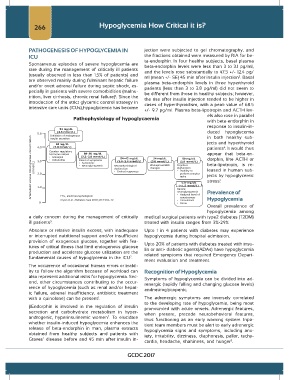
              PATHOGENESIS OF HYPOGLYCEMIA IN                    jection were  subjected to gel  chromatography, and
              ICU                                                the fractions obtained were measured by RIA for be-
                                                                 ta-endorphin. In four healthy subjects, basal plasma
              Spontaneous episodes  of  severe  hypoglycemia  are   beta-endorphin levels were less than 3 to 3.1 pg/ml,
              rare  during  the management  of critically ill  patients   and the levels rose substantially to 47.5 +/- 12.4 pg/
              (usually observed  in less  than  1.5% of patients) and   ml (mean +/- SE) 45 min after insulin injection . Basal
                                                                                                          3
              are observed mainly during fulminant hepatic failure   plasma  beta-endorphin levels  in three  hyperthyroid
              and/or overt adrenal failure during septic shock, es-  patients (less  than  3 to 3.8  pg/ml)  did not  seem  to
              pecially in patients with severe comorbidities (malnu-  be different from those in healthy subjects; however,
                                                    4
              trition, liver cirrhosis, chronic renal failure) . Since the   the rise after insulin injection tended to be higher in
              introduction of the strict glycemic control strategy in   cases of hyperthyroidism, with a peak value of 68.5
              intensive care units (ICUs),hypoglycemia has become
                                                                 +/- 9.7 pg/ml. Plasma beta-lipotropin and ACTH lev-
                                                                                            els also rose in parallel
                                                                                            with beta-endorphin in
                                                                                            response to insulin-in-
                                                                                            duced  hypoglycemia
                                                                                            in both  healthy sub-
                                                                                            jects and hyperthyroid
                                                                                            patients . It would thus
                                                                                                    4
                                                                                            appear  that  beta-en-
                                                                                            dorphin,  like  ACTH  or
                                                                                            beta-lipotropin,  is  re-
                                                                                            leased  in human sub-
                                                                                            jects by hypoglycemic
                                                                                            stress .
                                                                                                  1
                                                                                            Prevalence of
                                                                                            Hypoglycemia
                                                                                            Overall prevalence of
                                                                                            hypoglycemia  among
              a  daily  concern during  the management of  critically   medical surgical patients with type2 diabetes (T2DM)
              ill patients .                                     treated with insulin ranges from 3%-29%
                       5
              Absolute or  relative  insulin excess,  with  inadequate   Upto  1  in 4 patients with diabetes  may experience
              or  interrupted  nutritional support  and/or  insufficient   hypoglycemia during hospital admission.
              provision  of exogenous  glucose, together with  fea-  Upto 20% of patients with diabetes treated with insu-
              tures of critical illness that limit endogenous glucose   lin or anti- diabetic agents(ADAs) have hypoglycemia
              production and accelerate glucose utilization are the   related  symptoms that  required  Emergency Depart-
              fundamental causes of hypoglycemia in the ICU .
                                                          2
                                                                 ment evaluation and treatment.
              The occurrence of occasional human errors or inabil-
              ity to follow the algorithm because of workload can   Recognition of Hypoglycemia
              also represent additional risks for hypoglycemia. Sec-  Symptoms of hypoglycemia can be divided into ad-
              ond, other  circumstances  contributing  to the occur-  renergic (rapidly falling and changing glucose levels)
              rence of hypoglycemia (such as renal and/or hepat-  andneuroglycopenic.
              ic failure,  adrenal  insufficiency, antibiotic  treatment
              with a quinolone) can be present . 1               The  adrenergic symptoms  are  inversely  correlated
                                                                 to the developing rate of hypoglycemia, being most
              βEndorphin is involved in the regulation  of insulin   pronounced with acute  onsets. Adrenergic  features,
              secretion  and carbohydrate metabolism in hyper-   when present,  precede  neurobehavioral features,
              androgenic, hyperinsulinemic women . To elucidate   thus functioning  as  an early  warning  system.  Inpa-
                                                 2
              whether insulin-induced hypoglycemia enhances the   tient team members must be alert to early adrenergic
              release  of beta-endorphin in man,  plasma extracts   hypoglycemia  signs  and symptoms, including anx-
              obtained  from healthy  subjects and  patients with   iety,  irritability, dizziness, diaphoresis,  pallor,  tachy-
              Graves’ disease  before  and 45 min  after insulin in-
                                                                                                       3
                                                                 cardia, headache, shakiness, and hunger .

                                                         GCDC 2017

