


Page 291 - fbkCardioDiabetes_2017
P. 291
Cardio Diabetes Medicine 2017                                   267


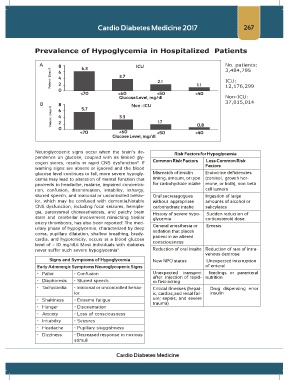
                  A        8         6.3                     ICU
                       Patient - Days %  6            3.7             2.1
                           4
                           2
                           0                                                            1.1
                                     <70             <60              <50              <40
                                                      Glucose Level, mg/dl
                   B       8         5.7                   Non - ICU
                        Patient - Days %  6           3.3             1.7

                           4
                           2
                           0                                                            0.8
                                    <70               <60             <50              <40
                                                   Glucose Level, mg/dl


                 Neuroglycopenic  signs  occur  when  the brain’s de-         Risk Factors for Hypoglycemia
                 pendence on glucose,  coupled with its  limited gly-
                 cogen stores,  results  in rapid  CNS  dysfunction .  If   Common Risk Factors    Less Common Risk
                                                             5
                 warning signs  are  absent or  ignored  and the blood                      Factors
                 glucose level continues to fall, more severe hypogly-  Mismatch of insulin   Endocrine deficiencies
                 cemia may lead to alteration of mental function that   timing, amount, or type  (cortisol,  growth hor-
                 proceeds to headache, malaise, impaired concentra-  for carbohydrate intake  mone, or both), non–beta
                 tion,  confusion,  disorientation, irritability,  lethargy,                cell tumors
                 slurred speech, and irrational or uncontrolled behav-  Oral secretagogues   Ingestion of large
                 ior,  which may  be  confused  with dementia.Notable   without  appropriate   amounts of alcohol or
                 CNS  dysfunction, including focal seizures,  hemiple-  carbohydrate intake   salicylates
                 gia, paroxysmal choreoathetosis, and  patchy  brain   History of severe hypo-   Sudden reduction of
                 stem and  cerebellar  involvement  mimicking basilar   glycemia            corticosteroid dose
                 artery thrombosis, has also been reported . The med-  General anesthesia or    Emesis
                                                       1
                 ullary phase of hypoglycemia, characterized by deep   sedation that places
                 coma,  pupillary  dilatation,  shallow breathing, brady-  patient in an altered
                 cardia, and hypotonicity, occurs at a blood glucose   consciousness
                 level  of ~ 10 mg/dl.6 Most individuals with  diabetes
                 never suffer such severe hypoglycemia 4            Reduction of oral intake Reduction of rate of intra-
                                                                                            venous dextrose
                       Signs and Symptoms of Hypoglycemia           New NPO status           Unexpected interruption
                 Early Adrenergic Symptoms Neuroglycopenic Signs                            of enteral
                 •  Pallor        • Confusion                       Unexpected  transport   feedings  or  parenteral
                                                                    after  injection of rapid-  nutrition
                 •  Diaphoresis   • Slurred speech                  or fast-acting
                 •  Tachycardia   • Irrational or uncontrolled behav-  Critical illnesses (hepat-  Drug dispensing  error
                                  ior                               ic, cardiac,and renal fail-  insulin
                 •  Shakiness     • Extreme fatigue                 ure; sepsis;  and severe
                                                                    trauma)
                 •  Hunger        • Disorientation
                 •  Anxiety       • Loss of consciousness
                 •  Irritability  • Seizures
                 •  Headache      • Pupillary sluggishness
                 •  Dizziness     • Decreased response to noxious
                                  stimuli


                                                    Cardio Diabetes Medicine

