


Page 521 - fbkCardioDiabetes_2017
P. 521
Cardio Diabetes Medicine 2017                                   497


                           Hyperglycemia  & Glycemic  Control in  ICU


                                               Prof. Dr. S. Arulrhaj MD.,FRCP (G)
                                                        Head, Acute Medicine

                                                  Dr.Aarathy Kannan,  M.D.,
                                                      Physician & Diabetologist
                                          Dr. Kiran Palsania & Dr.Bhuvaneshwar
                          Postgraduate in Internal Medicine, Sundaram Arulrhaj Hospitals, Tuticorin, India


                 INTRODUCTION                                       Intensive glycemic control reduces  morbidity  and
                                                                    mortality in critically ill patients, Hence hyperglycemia
                 Hyperglycemia is  a common  complication  of critical
                 illness, regardless of a history of diabetes mellitus. In   no longer benign in ICU.
                 many occasions Critically ill  patients without  Diabe-
                 tes can be hyperglycemic. It has an estimated prev-  OVERVIEW
                 alence of approximately 40% in hospitalized patients.  Hyperglycemia is exceedingly common in critical ill-
                 Initially, hyperglycemia was presumed to be an adap-  ness  and may be seen  in virtually all adult medical
                 tive stress  response  that  was beneficial to survival.   ICU patients when the threshold blood glucose (BG)
                 The fight-or-flight response.                      value is set at >110 mg/dL. In an observational study,
                                                                    ICU  patients with newly  diagnosed  hyperglycemia
                 Hyperglycemia  during acute illness  is  called  stress
                 hyperglycemia                                      had significantly higher mortality (31%) compared with
                                                                    patients with  known diabetes (10%)  or  normoglyce-
                 Stress  hyperglycemia  usually  is  defined  as  an in-  mia (11.3%).  Van  den Berghe  and  coworkers  in 2001
                 crease  in blood glucose  above 200  mg /  dL  in the   directly  addressed  this question and demonstrated
                 presence of acute illness.                         that  targeting  strict euglycemia  (80  to 110 mg/dL)
                                                                    can  lead to meaningful  morbidity and  mortality re-


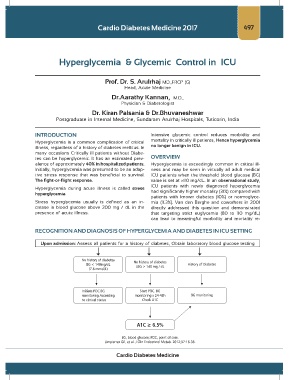
                 RECOGNITION AND DIAGNOSIS OF HYPERGLYCEMIA AND DIABETES IN ICU SETTING

                   Upon admission: Assess all patients for a history of diabetes, Obtain laboratory blood glucose testing


                                                    Cardio Diabetes Medicine

