


Page 522 - fbkCardioDiabetes_2017
P. 522
498                  Hyperglycemia & Glycemic  Control In  ICU


              ductions  among surgical  ICU patients supported  by   •  Increased hepatic gluconeogenesis  and  glycog-
              mechanical ventilation. (1)                          enolysis

                                                                 •  Impaired peripheral glucose uptake
              Three Types of Hyperglycemic Patient               •  And higher circulating levels of insulin
              •  Known history of diabetes                       Counter regulatory hormones, such  as glucagon,
                                                                 cortisol, growth  hormone, and catecholamine,  as
              •  Existing, but unrecognized, diabetes
                                                                 well as  elevated  levels  of cytokines  play  an  import-
              •  Stress hyperglycemia                            ant role in up-regulating hepatic glucose production.
                                                                 Some  of  these  hormones  and cytokines  have also
              HBA1C IS THE KEY FOR ASSESSING THE                 been shown to directly  oppose  insulin, resulting  in
              CONTROL OF DIABETES                                increased lipolysis  and  proteolysis,  which  serve  to
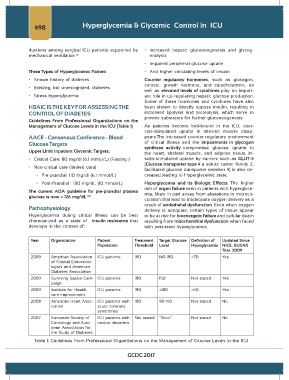
              Guidelines  From Professional Organizations  on the   provide substrates for further gluconeogenesis
              Management of Glucose Levels in the ICU (Table 1)  As patients become bed-bound  in the  ICU, exer-
                                                                 cise-stimulated uptake in skeletal  muscle disap-
              AACE - Consensus Conference - Blood                pears.The increased counter regulatory environment
              Glucose Targets                                    of critical illness  and the  impairments  in glycogen
                                                                 synthase  activity  compromise  glucose uptake  in
              Upper Limit Inpatient Glycemic Targets:            the  heart, skeletal  muscle,  and  adipose  tissue. In-
              •  Critical Care: 110 mg/dl (6.1 mmol/L) (Fasting )   sulin-stimulated uptake  by  carriers  such as  GLUT-4
                                                                 (Glucose transporter type 4 a solute carrier  family 2,
              •  Non-critical care (limited data)
                                                                 facilitated glucose transporter member 4) is also de-
                 •  Pre-prandial: 110 mg/dl (6.1 mmol/L)         creased,leading to Hyperglycemic state.
                 •  Post-Prandial : 180 mg/dL (10 mmol/L)        Hyperglycemia and  Its Biologic Effects:  The  higher
                                                                 risk of organ failure seen in patients with hyperglyce-
              The  current  ADA  guideline  for  pre-prandial plasma   mia, likely in part arises from alterations in microcir-
              glucose is now < 126 mg/dL  (2)
                                                                 culation that lead to inadequate oxygen delivery as a
                                                                 result of endothelial dysfunction. Even when oxygen
              Pathophysiology                                    delivery  is  adequate, certain types  of  tissue  appear
              Hyperglycemia  during critical illness  can  be best   to be at risk for bioenergetic failure and cellular death
              characterized as  a  state of    insulin  resistance  that   resulting from mitochondrial dysfunction when faced
              develops in the context of:                        with persistent hyperglycemia.

               Year     Organization        Patient         Treatment   Target Glucose   Definition of   Updated Since
                                            Population      Threshold  Level         Hypoglycemia  NICE_SUGAR
                                                                                                   Trial, 2009
               2009     American Association   ICU patients  180       140-180       <70           Yes
                        of Clinical Endocrinol-
                        ogists and American
                        Diabetes Association
               2009     Surviving Sepsis Cam- ICU patients  180        150           Not stated    Yes
                        paign
               2009     Institute for Health-  ICU patients  180       <180          <40           Yes
                        care Improvement
               2008     American Heart Asso-  ICU patients with   180  90-140        Not stated    No
                        ciation             acute coronary
                                            syndromes
               2007     European Society of   ICU patients with   Not stated  “Strict”   Not stated  No
                        Cardiology and Euro-  cardiac disorders
                        pean Association for
                        the Study of Diabetes
                Table 1: Guidelines From Professional Organizations on the Management of Glucose Levels in the ICU


                                                         GCDC 2017

