


Page 582 - fbkCardioDiabetes_2017
P. 582
558                      Cardio Diabetes Medicine 2017


               Meta-analysis,      Type of studies    Sulphonylurea vs                          Pooled point e
               authors & year      included (n)     comparator              Outcome             stimates (95% CI)
                                   RCT (5)         SU vs no SU              Cardiovascular morbidity  0.89 (0.71–1.11)
               Selvin et al., 2008  RCT (5)        SU vs no SU              Cardiovascular mortality  0.92 (0.68–1.26)
                                   RCT (6)         SU vs no SU              All-cause mortality  0.90 (0.70–1.15)
                                                   SU + MET vs diet, MET    Cardiovascular mortality
                                   Observational (5)                                            1.43 (1.10–1.85)
                                                   monotherapy, SU monotherapy  or hospitalization
                                                   SU + MET vs diet, MET
               Rao et al., 2008    Observational (4)                        Cardiovascular mortality  1.29 (0.73–2.27)
                                                   monotherapy, SU monotherapy
                                                   SU + MET vs diet, MET
                                   Observational (7)                        All-cause mortality  1.19 (0.88–1.62)
                                                   monotherapy, SU monotherapy
                                   Observational (9)  SU vs no SU           Cardiovascular mortality  1.27 (1.18–1.34)
               Phung et al., 2013
                                   RCT (7)         SU vs no SU              Cardiovascular mortality  1.22 (0.63–2.39)
                                   RCT (30)        SU vs no SU              MACE                1.08 (0.86–1.36)
               Monami et al., 2013
                                   RCT (37)        SU vs no SU              All-cause mortality  1.22 (1.01–1.49)
                                   RCT (3)         SU monotherapy vs MET    Cardiovascular morbidity  0.67 (0.48–0.93)
               Hemmingsen et al., 2013*  RCT (6)   SU monotherapy vs MET    Cardiovascular mortality  1.47 (0.54–4.01)
                                   RCT (6)         SU monotherapy vs MET    All-cause mortality  0.98 (0.61–1.58)
                                   Observational (4)  SU vs no SU           Cardiovascular mortality  2.72 (1.95–3.79)
               Forst et al., 2013
                                   Observational (12)  SU vs no SU          All-cause mortality  1.92 (1.48–2.49)
               Zhang et al., 2014  RCT (4)         DPP-4 inhibitors vs SU   Cardiovascular events  0.53 (0.32–0.87)
                                                   Chlorpropamide vs glyburide                  1.34 (0.98–1.86)
                                                   Tolbutamide vs glyburide                     1.13 (0.90–1.42)
                                   RCT (7),
               Simpson et al., 2015                Glipizide vs glyburide   All-cause mortality  0.98 (0.80–1.19)
                                   observational (17)
                                                   Glimepiride vs glyburide                     0.83 (0.68–1.00)
                                                   Gliclazide vs glyburide                      0.65 (0.53–0.79)
               VarvakiRados D et al.,   RCT (47)   SU vs active control     All-cause mortality Car-  1.12 (0.96- 1.30)
               2016                                                         diovascular mortality   1.12 (0.87 -1.42)
               * AD, antidiabetic drug; CI, confidence interval; DPP-4, dipeptidyl peptidase-4; MACE, major adverse cardiovascular event; MET, metformin; RCT, randomized
               controlled trial; SU, sulphonylurea. *Only results comparing second generation sulfonylureas against metformin are shown.
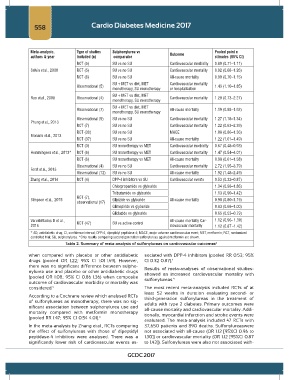
                              Table 2. Summary of meta-analysis of sulfonylureas on cardiovascular outcomes 4

              when  compared with  placebo or other antidiabetic   sociated with DPP-4 inhibitors (pooled RR 0.53; 95%
              drugs  (pooled OR  1.22; 95% CI 1.01–1.49).  However,   CI 0.32–0.87). 4
              there was no significant difference between sulpho-  Results  of  meta-analyses  of  observational  studies-
              nylurea use and placebo or other antidiabetic drugs   showed an  increased cardiovascular  mortality with
              (pooled  OR  1.08;  95% CI 0.86–1.36)  when  composite   sulfonylureas. 4
              outcome of cardiovascular morbidity or mortality was
              considered. 4                                      The most recent meta-analysis included  RCTs  of at
                                                                 least  52 weeks  in duration  evaluating second-  or
              According to a Cochrane review which analysed RCTs   third-generation sulfonylureas  in the treatment  of
              of sulfonylureas as monotherapy, there was no sig-  adults with type 2 diabetes. Primary outcomes were
              nificant association between sulphonylurea use and   all-cause mortality and cardiovascular mortality. Addi-
              mortality compared with metformin monotherapy      tionally, myocardial infarction and stroke events were
              (pooled RR 1.47; 95% CI 0.54–4.01). 4
                                                                 evaluated.  The meta-analysis included  47 RCTs  with
              In the meta-analysis by Zhang et al., RCTs comparing   37,650 patients and 890 deaths. Sulfonylureaswere
              the effect of  sulfonylureas  with those  of  dipeptidyl   not associated with all-cause (OR 1.12 [95%CI 0.96 to
              peptidase-4  inhibitors were  analysed. There  was a   1.30]) or cardiovascular mortality (OR 1.12 [95%CI 0.87
              significantly lower  risk  of cardiovascular events as-  to 1.42]). Sulfonylureas were also not associated with-


                                                         GCDC 2017

