


Page 623 - fbkCardioDiabetes_2017
P. 623
Cardio Diabetes Medicine 2017                                   599


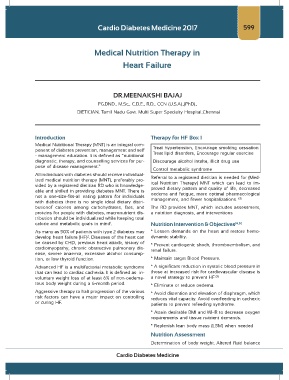
                                           Medical Nutrition Therapy in


                                                       Heart Failure


                                                   DR.MEENAKSHI BAJAJ

                                            PG.DND., M.Sc., C.D.E., R.D., CCN (U.S.A).,(PhD).,
                                   DIETICIAN, Tamil Nadu Govt. Multi Super Specialty Hospital,Chennai


                 Introduction                                       Therapy for HF Box 1
                 Medical Nutritional Therapy (MNT) is an integral com-
                 ponent of diabetes prevention, management and self   Treat  hypertension,  Encourage  smoking  cessation
                 - management education. It is defined as “nutritional   Treat lipid disorders, Encourage regular exercise
                 diagnostic, therapy, and counselling services for pur-  Discourage alcohol intake, illicit drug use
                 pose of disease management.”
                                                                    Control metabolic syndrome
                 All individuals with diabetes should receive individual-
                 ized medical nutrition therapy (MNT), preferably pro-  Referral to a registered dietitian is needed for (Med-
                 vided by a registered dietitian RD who is knowledge-  ical Nutrition Therapy)  MNT which  can  lead  to im-
                 able and skilled in providing diabetes MNT. There is   proved dietary pattern and quality of life, decreased
                 not  a one-size-fits-all  eating pattern for individuals   oedema and fatigue, more  optimal pharmacological
                                                                                                          (3)
                 with diabetes  there  is  no single  ideal  dietary  distri-  management, and fewer hospitalizations.
                 butionof  calories  among carbohydrates, fats, and   The  RD provides  MNT,  which  includes assessment,
                 proteins for people with diabetes, macronutrient dis-  a nutrition diagnosis, and interventions
                 tribution should be individualized while keeping total
                 calorie and metabolic goals in mind . 1            Nutrition Intervention & Objectives  (4,5)
                 As many as 50% of patients with type 2 diabetes may   * Lessen  demands  on the  heart and  restore  hemo-
                                        2
                 develop heart failure (HF) . Diseases of the heart can   dynamic stability.
                 be caused by CHD, previous heart attack, history of   * Prevent cardiogenic shock, thromboembolism, and
                 cardiomyopathy, chronic  obstructive  pulmonary dis-  renal failure.
                 ease, severe  anaemia,  excessive  alcohol  consump-
                 tion, or low thyroid function.                     * Maintain target Blood Pressure.

                 Advanced HF is a multifactorial metabolic syndrome   * A significant reduction in systolic blood pressure in
                 that can lead to cardiac cachexia. It is defined as  in-  those at increased risk for cardiovascular disease is
                 voluntary weight loss of at least 6% of non-oedema-  a novel strategy to prevent HF  (3)
                 tous body weight during a 6-month period.          * Eliminate or reduce oedema.
                 Aggressive therapy to halt progression of the various   * Avoid distention and elevation of diaphragm, which
                 risk  factors can  have  a major  impact  on controlling   reduces vital capacity. Avoid overfeeding in cachexic
                 or curing HF.                                      patients to prevent refeeding syndrome.

                                                                    * Attain desirable BMI and WHR to decrease oxygen
                                                                    requirements and tissue nutrient demands.
                                                                    * Replenish lean body mass (LBM) when needed
                                                                    Nutrition Assessment

                                                                    Determination of  body  weight.  Altered  fluid balance

                                                    Cardio Diabetes Medicine

