


Page 624 - fbkCardioDiabetes_2017
P. 624
600                      Medical Nutrition Therapy in Heart Failure


              complicates assessment of body weight in the pa-   For persons with hypertension, the DASH diet is rec-
              tient with HF. Weights should be taken before eating   ommended  with  adequate potassium,  calcium,  and
              and after voiding at the same time each day followed   magnesium.Sodium intake less  than  2 g/d  to im-
              by evaluation of Body Mass Index  4                prove clinical symptoms and quality of life  (3).
              Waist circumference; waist to hip ratio (WHR)      A one-size-fits-all sodium restriction is not possible.
                                                                 The HF stage, amount of oedema present, overall nu-
              Dietary  assessment  for:  SFA, -fatty acids, omega-3   tritional status, and medications must be taken into
              fatty acids, fibre, sodium, alcohol, sugar and phyto-  consideration. There  is consensus that  high sodium
              nutrients
                                                                 intake (above 3 g/day) is contraindicated for HF.
              Anorexia  • Nausea, abdominal pain and  feeling  of
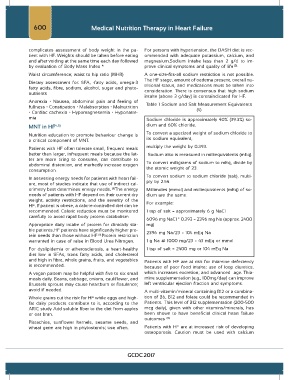
              fullness • Constipation • Malabsorption • Malnutrition   Table 1 Sodium and Salt Measurement Equivalents
              • Cardiac cachexia • Hypomagnesemia • Hyponatre-                          (4)
              mia                                                 Sodium chloride is approximately  40%  (39.3%)  so-
              MNT in Hf  (4,5)                                    dium and 60% chloride.
              Nutrition education to promote behaviour change is   To convert a specized weight of sodium chloride to
              a critical component of MNT.                        its sodium equivalent,
                                                                  multiply the weight by 0.393.
              Patients with HF often tolerate small, frequent meals
              better than larger, infrequent meals because the lat-   Sodium also is measured in milliequivalents (mEq).
              ter  are  more  tiring  to consume, can  contribute  to
              abdominal distention, and markedly increase oxygen   To convert milligrams of sodium to mEq, divide by
              consumption.                                        the atomic weight of 23.
                                                                  To convert sodium to sodium chloride (salt), multi-
              In assessing energy needs for patients with heart fail-
              ure, most of studies indicate that use of indirect cal-  ply by 2.54.
              orimetry best determines energy needs.  The energy   Millimoles (mmol) and milliequivalents (mEq) of so-
                                                  (3)
              needs of patients with HF depend on their current dry   dium are the same.
              weight, activity  restrictions, and the severity  of the
              HF. If patient is obese, a calorie-controlled diet can be   For example:
              recommended. Caloric reduction must be monitored    1 tsp of salt = approximately 6 g NaCl
              carefully to avoid rapid body protein catabolism
                                                                  6096 mg NaCl * 0.393 = 2396 mg Na (approx. 2400
              Appropriate  daily  intake of protein  for  clinically sta-  mg)
              ble patients,HF patients have significantly higher pro-  2396 mg Na/23 = 104 mEq Na
              tein needs than those without HF Protein restriction
                                             (3).
              warranted in case of raise in Blood Urea Nitrogen.  1 g Na # 1000 mg/23 = 43 mEq or mmol
              For dyslipidemia or atherosclerosis,  a heart-healthy   1 tsp of salt = 2400 mg or 104 mEq Na
              diet low in SFAs, trans fatty acids,  and  cholesterol
              and high in fibre, whole grains, fruits, and vegetables   Patients with HF are at risk for thiamine defeciency
              is recommended.                                    because of poor  food intake; use of loop  diuretics,
              A vegan pattern may be helpful with five to six small   which increases excretion; and advanced  age. Thia-
              meals daily. Beans, cabbage, onions, cauliflower, and   mine supplementation (e.g., 100mg/day) can improve
              Brussels sprouts may cause heartburn or flatulence;   left ventricular ejection fraction and symptoms.
              avoid if needed.                                   A multi-vitamin/mineral containing B12 or a combina-
              Whole grains cut the risk for HF while eggs and high-  tion of B6, B12 and folate could be recommended in
              fat dairy  products contribute to it, according to the   Patients.  This level of B12 supplementation (200-500
              ARIC study Add soluble fiber to the diet from apples   mcg daily), given with other vitamins/minerals, has
              or oat bran.                                       been  shown to have beneficial clinical heart failure
                                                                 outcomes  (3).
              Pistachios, sunflower  kernels,  sesame  seeds,  and
              wheat germ are high in phytosterols; use often.    Patients with HF are at increased risk of developing
                                                                 osteoporosis.  Caution  must  be  used  with calcium


                                                         GCDC 2017

