


Page 74 - fbkCardioDiabetes_2017
P. 74
50                           Cardio Diabetes Medicine 2017


              ic female controls. This data confirms that diabetes,   diabetic female patients. The INTERHEART  study of
              even at an early stage, attenuates the protective ef-  risk  factors  for  CVD identified  diabetes  mellitus  as
              fect of female sex and increases the risk for CVD in   one of the greatest risk factor for women, as diabetic
              females to a greater extent than in males.         women had a threefold to fourfold increased risk of
                                                                 developing CVD compared to men. (4)

                                                                 Sex differences in symptoms of IHD
                                                                 *) women  report  more angina  despite  lower  rate of
                                                                 obstructive CAD.
                                                                 *) Meta analysis of 74 reports from 13,311 women and
                                                                 11511 men, prevalence of angina is 11% to 27% greater
                                                                 for women less than 65yrs.
                                                                 *) women have lesser obstructive CAD regardless of
                                                                 symptoms and continue to have signs and symptoms
                                                                 of ischemia,  repeat  hospitalization,  consumption  of
                                                                 health care resources.
                                                                 Studies demonstrate under-treatment of women with
                                                                 medication  compared  with men. Both studies  also
                                                                 show gender differences in use of procedures. While
                                                                 increasing knowledge exists regarding pathophysio-
                                                                 logical  mechanistic  pathways for  “female-pattern”
                                                                 ischemic HD,  translational studies  aimed  at devel-
                                                                 oping practical diagnosis and therapeutics with both
                                                                 traditional and novel treatments are needed.
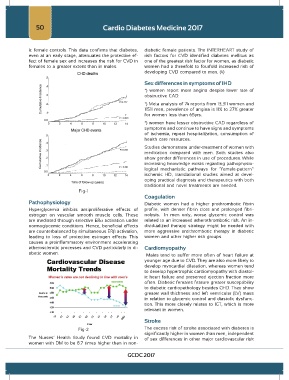
                                    Fig-1
                                                                 Coagulation
              Pathophysiology                                    Diabetic  women had a higher  prothrombotic fibrin
              Hyperglycemia  inhibits antiproliferative  effects of   profile,  with  denser  fibrin clots and  prolonged  fibri-
              estrogen  on vascular smooth muscle cells.  These   nolysis.    In men  only, worse glycemic control  was
              are mediated through selective ERα activation under   related to an increased atherothrombotic risk. An in-
              normoglycemic conditions. Hence, beneficial effects   dividualized therapy  strategy  might be needed  with
              are counterbalanced by simultaneous ERβ activation,   more  aggressive  antithrombotic therapy  in  diabetic
              leading  to loss  of protective estrogen  effects. This   women and other higher risk groups.
              causes a proinflammatory environment  accelerating
              atherosclerotic processes and CVD particularly in di-  Cardiomyopathy
              abetic women.                                        Males  tend  to suffer more often of heart failure at
                                                                 younger age due to CVD. They are also more likely to
                                                                 develop myocardial dilatation, whereas women tend
                                                                 to develop hypertrophic cardiomyopathy with diastol-
                                                                 ic heart failure and preserved ejection fraction more
                                                                 often. Diabetic females feature greater susceptibility
                                                                 to diabetic cardiopathology besides CHD. They show
                                                                 greater wall thickness and left ventricular (LV) mass
                                                                 in relation to glycemic control and diastolic dysfunc-
                                                                 tion. This more closely relates to IGT, which is more
                                                                 relevant in women.

                                                                 Stroke

                                   Fig-2                         The excess risk of stroke associated with diabetes is
                                                                 significantly higher in women than men, independent
              The  Nurses’  Health Study found CVD mortality in   of sex differences in other major cardiovascular risk
              women with DM to be 8.7 times higher than in non-

                                                         GCDC 2017

