


Page 153 - 2022-08-01 Paddling Magazine
P. 153
KAYAKING


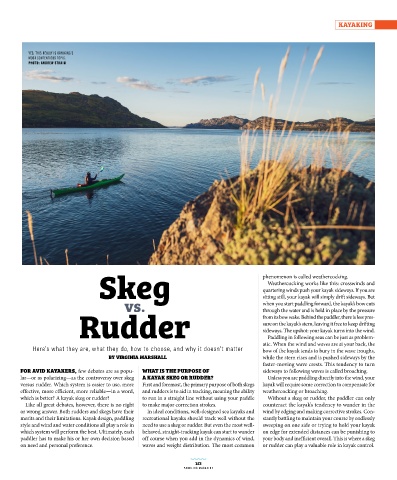
          YES, THIS REALLY IS KAYAKING'S
          MOST CONTENTIOUS TOPIC.
          PHOTO: ANDREW STRAIN


                                 Skeg                                                  phenomenon is called weathercocking.


                                                                                        Weathercocking works like this: crosswinds and
                                                                                       quartering winds push your kayak sideways. If you are
                                                                                       sitting still, your kayak will simply drift sideways. But
                                          vs.
                           Rudder                                                      when you start paddling forward, the kayak’s bow cuts
                                                                                       through the water and is held in place by the pressure
                                                                                       from its bow wake. Behind the paddler, there is less pres-
                                                                                       sure on the kayak’s stern, leaving it free to keep drifting
                                                                                       sideways. The upshot: your kayak turns into the wind.
                                                                                        Paddling in following seas can be just as problem-
                                                                                       atic. When the wind and waves are at your back, the
            Here's what they are, what they do, how to choose, and why it doesn't matter   bow of the kayak tends to bury in the wave troughs,
                                    by virginia marshall                               while the stern rises and is pushed sideways by the
                                                                                       faster-moving wave crests. This tendency to turn
        FOR AVID KAYAKERS, few debates are as popu-  WHAT IS THE PURPOSE OF            sideways to following waves is called broaching.
        lar—or as polarizing—as the controversy over skeg   A KAYAK SKEG OR RUDDER?     Unless you are paddling directly into the wind, your
        versus rudder. Which system is easier to use, more   First and foremost, the primary purpose of both skegs   kayak will require some correction to compensate for
        effective, more efficient, more reliable—in a word,   and rudders is to aid in tracking, meaning the ability   weathercocking or broaching.
        which is better? A kayak skeg or rudder?  to run in a straight line without using your paddle   Without a skeg or rudder, the paddler can only
         Like all great debates, however, there is no right   to make major correction strokes.   counteract the kayak’s tendency to wander in the
        or wrong answer. Both rudders and skegs have their   In ideal conditions, well-designed sea kayaks and   wind by edging and making corrective strokes. Con-
        merits and their limitations. Kayak design, paddling   recreational kayaks should track well without the   stantly battling to maintain your course by endlessly
        style and wind and water conditions all play a role in   need to use a skeg or rudder. But even the most well-  sweeping on one side or trying to hold your kayak
        which system will perform the best. Ultimately, each   behaved, straight-tracking kayak can start to wander   on edge for extended distances can be punishing to
        paddler has to make his or her own decision based   off course when you add in the dynamics of wind,   your body and inefficient overall. This is where a skeg
        on need and personal preference.       waves and weight distribution. The most common   or rudder can play a valuable role in kayak control.


                                                                 153
                                                             P A D D L IN G  M A G A Z IN E

