


Page 154 - 2022-08-01 Paddling Magazine
P. 154
KAYAKING


                                                                                                                             PHOTO: NICHOLAS SPOONER


        PADDLING WITH A SKEG

        SO, WHEN IT COMES TO A KAYAK’S PERFOR-  HOW TO USE A KAYAK SKEG
        MANCE, how much does the skeg help? Beyond the   As mentioned, even a well-designed kayak will turn
        ability to help your kayak paddle straight in wind and   into the wind (weathercock) when the skeg is up.   WHAT IS THE DIFFERENCE
        current, skegs can also add versatility to kayak design.   When you lower the skeg fully, chances are you’ll   BETWEEN A SKEG AND
          Many recreational paddlers want a kayak that is   overcompensate, moving the kayak’s trim too far   A RUDDER?
        efficient and tracks well, but is also responsive and   toward the stern. Now your kayak will start turning
        maneuverable. Yet, as any kayak designer will tell   away from the wind.                WHAT IS A SKEG ON A KAYAK?
        you, tracking and turning ability in kayak design   Instead, you’ll want to slide your skeg down a little   A skeg is a retractable fin that
        are a compromise, trading more of one for less of   at a time until you can hold course without any extra   drops out of a slot in the kayak hull
        the other. Incorporating a drop-down skeg allows   correction—or frustration. You can make subtle skeg   near the stern. The skeg fin cannot
        designers to build more versatile kayaks by blending   adjustments as required to trim the kayak to suit   turn side to side, but its depth can
        playful, maneuverable hulls with on-demand tracking.  variable conditions throughout your paddle.  be adjusted up and down using a
                                                                                                control slider, cleat or knob beside
                                                                                                the cockpit.
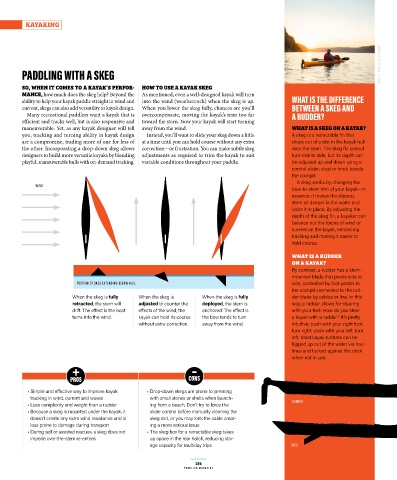
                                                                                                  A skeg works by changing the
             WIND
                                                                                                bow-to-stern trim of your kayak—in
                                                                                                essence, it makes the slippery
                                                                                                stern sit deeper in the water and
                                                                                                locks it in place. By adjusting the
                                                                                                depth of the skeg fin, a kayaker can
                                                                                                balance out the forces of wind or
                                                                                                current on the kayak, enhancing
                                                                                                tracking and making it easier to
                                                                                                hold course.
                                                                                                WHAT IS A RUDDER
                                                                                                ON A KAYAK?
                                                                                                By contrast, a rudder has a stern-
                                                                                                mounted blade that pivots side to
                          PORTION OF SKEG EXTENDING BELOW HULL                                  side, controlled by foot pedals in
                                                                                                the cockpit connected to the rud-
                         When the skeg is fully    When the skeg is   When the skeg is fully    der blade by cables or line. In this
                         retracted, the stern will   adjusted to counter the   deployed, the stern is   way, a rudder allows for steering
                         drift. The effect is the boat   effects of the wind, the   anchored. The effect is   with your feet. How do you steer
                         turns into the wind.  kayak can hold its course   the bow tends to turn   a kayak with a rudder? It’s pretty
                                              without extra correction.  away from the wind.    intuitive: push with your right foot,
                                                                                                turn right; push with your left, turn
                                                                                                left. Most kayak rudders can be
                                                                                                flipped up out of the water via haul
                                                                                                lines and tucked against the deck
                                                                                                when not in use.
                         +                                      –
                        PROS                                   CONS

          •  Simple and effective way to improve kayak   •  Drop-down skegs are prone to jamming
           tracking in wind, current and waves    with small stones or shells when launch-
          •  Less complexity and weight than a rudder  ing from a beach. Don’t try to force the   RUDDER
          •  Because a skeg is mounted under the kayak, it   slider control before manually cleaning the
           doesn’t create any extra wind resistance and is   skeg slot, or you may kink the cable creat-
           less prone to damage during transport  ing a more serious issue
          •  During self or assisted rescues, a skeg does not   •  The skeg box for a retractable skeg takes
           impede over-the-stern re-entries       up space in the rear hatch, reducing stor-
                                                  age capacity for multiday trips               SKEG


                                                                 154
                                                             P A D D L IN G  M A G A Z IN E

