


Page 59 - English Class 9
P. 59
effusive apologies in  2010,  after  widespread reports of  malfunctioning
            Prius accelerators.  Japan, for its part,  bristled when a US submarine
            commander didn’t immediately apologise after colliding with and sinking
            a Japanese fishing boat off Hawaii in 2001.

            The confusion over the meaning of and occasion for “I’m sorry” extends
            beyond those countries; indeed, it seems that virtually every culture has
            its own rules. In India, other researchers have noted, apologies are far less
            common than in Japan. In Hong Kong, they are so prevalent and ritualised
            that many people are inured to them.

            Our own  work found  that a  core  issue  is  differing perceptions of
            culpability: Americans see an apology as an admission  of wrongdoing,
            whereas Japanese see it as an expression of eagerness to repair a damaged
            relationship, with no culpability necessarily implied. And this difference,
            we discovered, affects how much traction an apology gains.

            In an initial survey of US and Japanese undergraduates, the US students
            were more likely to say that an apology directly implied guilt. The Japanese
            students were  more  likely to apologise
            even when they weren’t personally
            responsible for  what had happened.
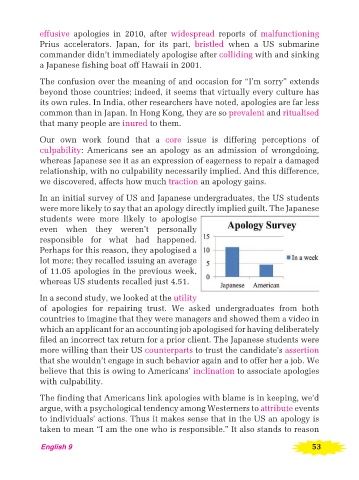
            Perhaps for this reason, they apologised a
            lot more; they recalled issuing an average
            of 11.05 apologies in the previous week,
            whereas US students recalled just 4.51.

            In a second study, we looked at the utility
            of apologies for repairing trust. We asked undergraduates  from both
            countries to imagine that they were managers and showed them a video in
            which an applicant for an accounting job apologised for having deliberately
            filed an incorrect tax return for a prior client. The Japanese students were
            more willing than their US counterparts to trust the candidate’s assertion
            that she wouldn’t engage in such behavior again and to offer her a job. We
            believe that this is owing to Americans’ inclination to associate apologies
            with culpability.

            The finding that Americans link apologies with blame is in keeping, we’d
            argue, with a psychological tendency among Westerners to attribute events
            to individuals’ actions. Thus it makes sense that in the US an apology is
            taken to mean “I am the one who is responsible.” It also stands to reason

             English 9                                                                    53

