


Page 9 - Metroid Mag - November 2016_Neat2
P. 9
METROID MAG             9


                         INNOVATION
          4

                         TRENDS IN


                         MANUFACTURING


      Amid an increasingly globalised economy, manufacturing in Australia in recent
      years has faced some very difficult times. In order to survive, manufacturers need
      to invest in and drive technological innovation in every part of their business.
      Let’s have a look at some of the main trends in manufacturing innovation and
      technology today.


        1. IoT and data-driven analytics     2. Customisation                     3. Robotics
        The Internet of Things (IoT) is a concept which   Manufacturing, particularly in developed   Industrial robots have been around since the
        describes how everyday physical devices and   countries like Australia, is no longer about   1950’s. But robotics today is more advanced
        objects can be connected to the Internet, to   mass production. Consumers expect a   and intelligent than ever - from flexible robots
        relay information about themselves.  more  customised,  tailored  product  to  that can be easily ‘re-trained’ to perform new
        In a manufacturing context, the implementa-  suit their needs. Successful manufactur-  tasks, to robots designed to ‘co-work’ with
        tion of IoT can enable real-time visibility into   ers have leveraged this shift in consumer  humans (known as cobotics). Still, particularly
        every stage of your production process; it can   thinking  and  offered  a  customisable  in Asia, robots continue to take the place of
        monitor and track the movements of staff, raw   product or ‘experience’ to their custom-  factory workers - Foxconn earlier this year
        materials and finished products; the IoT con-  ers - and they’re reaping the benefits in   replaced 60,000 workers with a number of
        cept can even be the kernel of a completely   increased sales and customer loyalty.  industrial robots.
        new product or service you can offer the mar-
        ket. Pure data collection is not enough: lead-
        ing manufacturers are leveraging computing
        resources to analyse vast volumes of collected
        data, in view of recommending and implement-
        ing process changes to optimise production
        capacity and efficiency.


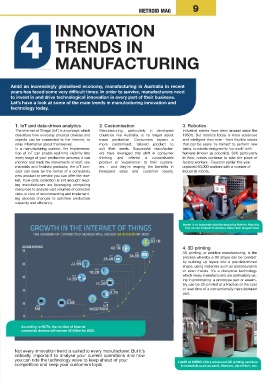
                                                                                  Baxter is an industrial robot developed by Rethink Robotics
                                                                                   that can be ‘trained’ to do tasks rather than programmed.


                                                                                  4. 3D printing
                                                                                  3D printing, or additive manufacturing, is the
                                                                                  process whereby a 3D shape can be ‘printed’
                                                                                  by building up layers into a pre-determined
                                                                                  shape, using materials such as plastics,resins
                                                                                  or even metals. It’s a disruptive technology
                                                                                  which many manufacturers are particularly us-
                                                                                  ing in prototyping: a prototype part or assem-
                                                                                  bly can be 3D-printed at a fraction of the cost
                                                                                  or lead time of a conventionally manufactured
                                                                                  part.


           According to NCTA, the number of internet
           connected devices will exceed 50 billion by 2020.


        Not every innovation trend is suited to every manufacturer. But it’s
        critically important to analyse your current operations and how
        you can ride the technology wave to keep ahead of your
        competition and keep your customers loyal.                              Lab22 at CSIRO offers advanced 3D printing services
                                                                                 in materials such as sand, titanium, aluminium, etc.

