


Page 215 - Physics Form 5 KSSM_Neat
P. 215
The concept of half-life can also be expressed in the form of a decay series as follow:    CHAPTER 6
                                                          N
                                         N
                                                 N
                                                                         1
                                 N   ˜  ( )   ˜  ( )   ˜  ( )   ˜ …  ˜  ( ) n N
                                                           0
                                          0
                                                   0
                                   0  T 1   2  T 1   4  T 1   8  T 1   T 1  2  0                         Nuclear Physics
                                      2       2        2       2      2
                                                                 1
              Number of radioactive nuclei that has not decayed, N =  ( ) n N 0
                                                                 2
              KEMENTERIAN PENDIDIKAN MALAYSIA
              where  N = the initial number of radioactive nuclei
                      0
                     n = number of half-life (limited to positive integers)
                    T 1 = half-life of radioactive substances
                      2
                 Table 6.2 shows the change in the number of radioactive nuclei in five half-life.
                            Table 6.2 The change in the number of radioactive nuclei in five half-life
                                Initial
             Half-life        condition      T 1 2      2T 1 2      3T 1 2     4T 1 2      5T 1 2
             Number of           N 0        1 N      ( )  N        ( )  N    ( )  N     ( )  N
                                                      1 2
                                                                                         1 5
                                                                    1 3
                                                                              1 4
             radioactive                    2  0      2   0         2   0     2   0      2   0
                                                                     1
                                                       1
             nuclei has not                          =  N          =  N      =   1  N   =   1  N
             decayed                                   4  0          8  0     16  0       32  0
                                                          1
                                                                     1
                                              1
             Number           N  – N  = 0  N  –  N   N  –  N     N  –  N     N  –   1  N  N  –   1  N
                               0
                                   0
             of decayed                    0  2  0     0  4  0    0  8  0     0  16  0    0  32  0
                                                                   7
                                            1
                                                       3
             radioactive                  =  N 0     =  N 0      =  N 0      =  15 N 0  =   31 N
             nuclei                         2          4           8          16          32  0
                Radioactive
                nuclei that has
                not decayed
                Decayed
                radioactive
                nuclei
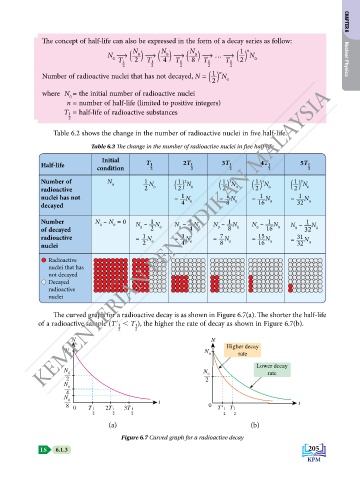
                 The curved graph for a radioactive decay is as shown in Figure 6.7(a). The shorter the half-life
             of a radioactive sample (Tʹ 1 , T 1), the higher the rate of decay as shown in Figure 6.7(b).
                                     2    2
                       N                                        N
                                                                     Higher decay
                    N                                         N
                      0                                         0       rate
                                                                              Lower decay
                    N                                         N
                    –– 0                                      –– 0               rate
                     2                                         2
                    N
                    –– 0
                     4
                    N
                    –– 0                         t                                         t
                     8  0   T    2T   3T                        0  T  1 '  T
                             – 1   1 –  1 –                         –  1 –
                             2     2    2                           2  2
                                  (a)                                       (b)
                                     Figure 6.7 Curved graph for a radioactive decay

             LS   6.1.3                                                                       205

