


Page 214 - Physics Form 5 KSSM_Neat
P. 214
5.  Repeat step 4 for 20 times.                                      SCAN ME
                                                                                 SCAN ME
            6.  Scan the QR code and print Table 6.1.                              Worksheet
            7.  Record the results of all the 10 groups in Table 6.1.              (Table 6.1)

            Results:
                                                   Table 6.1                   http://bit.ly/3j098S5
            KEMENTERIAN PENDIDIKAN MALAYSIA
               Number                            Number of dice left, N
               of throws  G1    G2    G3    G4    G5     G6    G7    G8    G9   G10 Average

                   0

                   1
                   2

                   3

            G1= Group 1
            Data analysis:
            Plot the graph of the number of dice left against the number of throws.
            Discussion:
            1.  From your graph, determine the following:
               (a)  the number of throws when the number of dice left becomes 30, 15 and 7.5
               (b)  the average time interval, for the number of dice left to be halved if each throw represents a
                  time of one minute
            2.  Will the results of your class change if this activity is repeated with the dice displaying
               number “1” for each throw?
            3.  What are the characteristics of the radioactive decay in this activity?


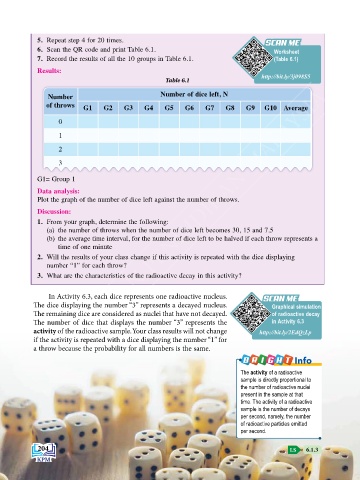
                In Activity 6.3, each dice represents one radioactive nucleus.   SCAN ME
                                                                                SCAN ME
           The dice displaying the number “3” represents a decayed nucleus.        Graphical simulation
           The remaining dice are considered as nuclei that have not decayed.      of radioactive decay
           The number of dice that displays the number “3” represents the          in Activity 6.3
           activity of the radioactive sample. Your class results will not change   http://bit.ly/2EdQzLp
           if the activity is repeated with a dice displaying the number “1” for
           a throw because the probability for all numbers is the same.

                                                                                         Info
                                                                         The activity of a radioactive
                                                                         sample is directly proportional to
                                                                         the number of radioactive nuclei
                                                                         present in the sample at that
                                                                         time. The activity of a radioactive
                                                                         sample is the number of decays
                                                                         per second, namely, the number
                                                                         of radioactive particles emitted
                                                                         per second.

            204                                                                         LS     6.1.3

