


Page 39 - Physics Form 5 KSSM_Neat
P. 39
3.  From the graph of F against x for spring S in Figure 1.38:                             CHAPTER 1
                (a)  determine the value of the spring constant, k by calculating the gradient of the graph.
                (b)  determine the elastic potential energy, E  when the spring is stretched to an
                                                     p
                   extension, x = 0.20 m by calculating the area under the graph.                        Force and Motion II
             Discussion:
             Based on your answers in steps 2 and 3, compare spring R and spring S from the aspects of:
              KEMENTERIAN PENDIDIKAN MALAYSIA
             (a)  the stiffness of the spring.
             (b)  the elastic potential energy that can be stored in the spring.


                 There are various types of springs and each spring has its own spring constant. What are
             the factors that affect the value of the spring constant?


                Activity        1.10

             Aim: To discuss the factors that affect the value of the spring constant
             Apparatus: Two pieces of 50 g slotted weights, half-metre rule and retort stand
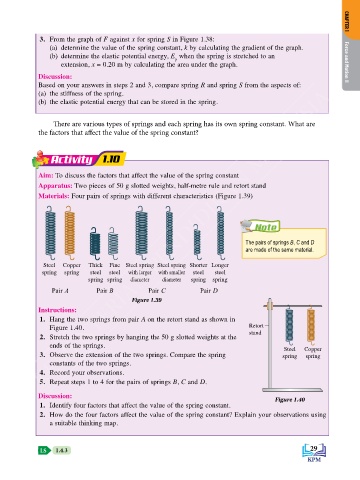
             Materials: Four pairs of springs with different characteristics (Figure 1.39)


                                                                              Note

                                                                           The pairs of springs B, C and D
                                                                           are made of the same material.

              Steel  Copper  Thick  Fine Steel spring Steel spring Shorter Longer
              spring  spring  steel  steel  with larger  with smaller  steel  steel
                           spring spring  diameter  diameter  spring  spring
                 Pair A       Pair B          Pair C         Pair D
                                         Figure 1.39
             Instructions:
              1.  Hang the two springs from pair A on the retort stand as shown in
                Figure 1.40.                                                Retort
                                                                            stand
              2.  Stretch the two springs by hanging the 50 g slotted weights at the
                ends of the springs.
                                                                                      Steel  Copper
              3.  Observe the extension of the two springs. Compare the spring        spring  spring
                constants of the two springs.
              4.  Record your observations.
              5.  Repeat steps 1 to 4 for the pairs of springs B, C and D.

             Discussion:
                                                                                    Figure 1.40
              1.  Identify four factors that affect the value of the spring constant.
              2.  How do the four factors affect the value of the spring constant? Explain your observations using
                a suitable thinking map.


             LS   1.4.3                                                                       29

