


Page 41 - NEDBANK YES BOOKLET
P. 41
Competency-based interviews

        Competency-based interviews, also called structured, situational or behavioural
        interviews, are based on the premise that past behaviour predicts future
        behaviour. The interviewer asks questions about specific situations and the
        candidate answers by describing how they have handled similar situations in
        the past.
        If you’re not used to answering competency-based interview questions, the
        STAR method is a useful way of communicating key points clearly and concisely.
        Use a wide variety of examples where possible, including during school or higher
        education, any previous employment or work experience, and in your daily life
        in general.

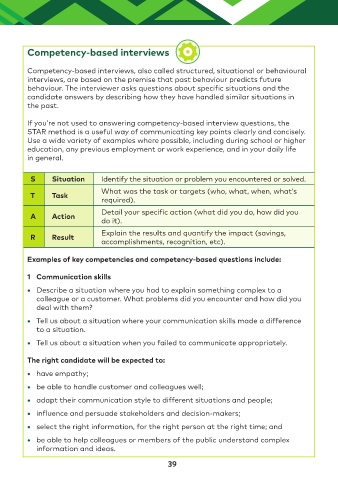
         S    Situation   Identify the situation or problem you encountered or solved.
                          What was the task or targets (who, what, when, what’s
         T    Task        required).

         A    Action      Detail your specific action (what did you do, how did you
                          do it).
         R    Result      Explain the results and quantify the impact (savings,
                          accomplishments, recognition, etc).
        Examples of key competencies and competency-based questions include:

        1  Communication skills
        •  Describe a situation where you had to explain something complex to a
          colleague or a customer. What problems did you encounter and how did you
          deal with them?
        •  Tell us about a situation where your communication skills made a difference
          to a situation.
        •  Tell us about a situation when you failed to communicate appropriately.

        The right candidate will be expected to:
        •  have empathy;
        •  be able to handle customer and colleagues well;
        •  adapt their communication style to different situations and people;
        •  influence and persuade stakeholders and decision-makers;
        •  select the right information, for the right person at the right time; and
        •  be able to help colleagues or members of the public understand complex
          information and ideas.
 38                                        39

