


Page 142 - Critical Care Nursing Demystified
P. 142
Chapter 3  CARE OF THE PATIENT WITH CRITICAL CARDIAC AND VASCULAR NEEDS        127


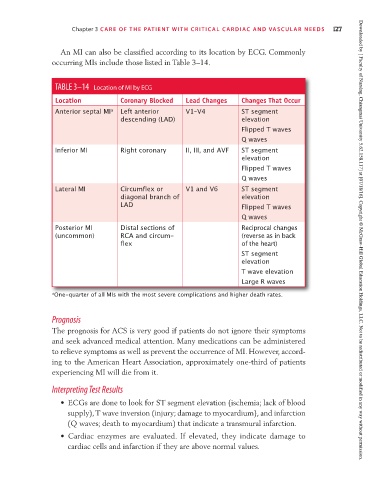
                                 An MI can also be classified according to its location by ECG. Commonly
                               occurring MIs include those listed in Table 3–14.


                               TABLE 3–14  Location of MI by ECG

                               Location           Coronary Blocked  Lead Changes    Changes That Occur
                               Anterior  septal MI a  Left anterior   V1–V4         ST segment
                                                  descending (LAD)                  elevation
                                                                                    Flipped T waves
                                                                                    Q waves
                               Inferior MI        Right coronary    II, III, and AVF  ST segment
                                                                                    elevation
                                                                                    Flipped T waves
                                                                                    Q waves
                               Lateral MI         Circumflex or     V1 and V6       ST segment
                                                  diagonal branch of                elevation
                                                  LAD                               Flipped T waves
                                                                                    Q waves
                               Posterior MI       Distal sections of                Reciprocal changes
                               (uncommon)         RCA and circum-                   (reverse as in back
                                                  flex                              of the heart)                   Downloaded by [ Faculty of Nursing, Chiangmai University 5.62.158.117] at [07/18/16]. Copyright © McGraw-Hill Global Education Holdings, LLC. Not to be redistributed or modified in any way without permission.
                                                                                    ST segment
                                                                                    elevation
                                                                                    T wave elevation
                                                                                    Large R waves
                               a One-quarter of all MIs with the most severe complications and higher death rates.


                               Prognosis
                               The prognosis for ACS is very good if patients do not ignore their symptoms
                               and seek advanced medical attention. Many medications can be administered
                               to relieve symptoms as well as prevent the occurrence of MI. However, accord-
                               ing to the American Heart Association, approximately one-third of patients
                               experiencing MI will die from it.

                               Interpreting Test Results
                                 •   ECGs are done to look for ST segment elevation (ischemia; lack of blood
                                   supply), T wave inversion (injury; damage to myocardium), and infarction
                                   (Q waves; death to myocardium) that indicate a transmural infarction.
                                 •   Cardiac enzymes are evaluated. If elevated, they indicate damage to
                                   cardiac cells and infarction if they are above normal values.

