


Page 144 - Critical Care Nursing Demystified
P. 144
Chapter 3  CARE OF THE PATIENT WITH CRITICAL CARDIAC AND VASCULAR NEEDS        129


                               Treatment

                                 Stop all activity.
                                 Administer oxygen.
                                 Give medications (ASA, anticoagulants, Lopressor, nitrates, thrombolytics).
                                 Prepare for coronary arteriogram, angioplasty, or open-heart surgery (OHS)
                                 if needed.


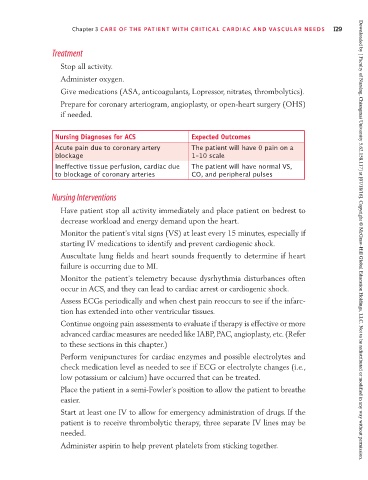
                               Nursing Diagnoses for ACS              Expected Outcomes
                               Acute pain due to coronary artery      The patient will have 0 pain on a
                                 blockage                             1–10 scale
                               Ineffective tissue perfusion, cardiac due   The patient will have normal VS,
                               to blockage of coronary arteries       CO, and peripheral pulses


                               Nursing Interventions
                                 Have patient stop all activity immediately and place patient on bedrest to
                                 decrease workload and energy demand upon the heart.
                                 Monitor the patient’s vital signs (VS) at least every 15 minutes, especially if
                                 starting IV medications to identify and prevent cardiogenic shock.                 Downloaded by [ Faculty of Nursing, Chiangmai University 5.62.158.117] at [07/18/16]. Copyright © McGraw-Hill Global Education Holdings, LLC. Not to be redistributed or modified in any way without permission.
                                 Auscultate lung fields and heart sounds frequently to determine if heart
                                 failure is occurring due to MI.
                                 Monitor the patient’s telemetry because dysrhythmia disturbances often
                                 occur in ACS, and they can lead to cardiac arrest or cardiogenic shock.

                                 Assess ECGs periodically and when chest pain reoccurs to see if the infarc-
                                 tion has extended into other ventricular tissues.

                                 Continue ongoing pain assessments to evaluate if therapy is effective or more
                                 advanced cardiac measures are needed like IABP, PAC, angioplasty, etc. (Refer
                                 to these sections in this chapter.)
                                 Perform venipunctures for cardiac enzymes and possible electrolytes and
                                 check medication level as needed to see if ECG or electrolyte changes (i.e.,
                                 low potassium or calcium) have occurred that can be treated.
                                 Place the patient in a semi-Fowler’s position to allow the patient to breathe
                                 easier.
                                 Start at least one IV to allow for emergency administration of drugs. If the
                                 patient is to receive thrombolytic therapy, three separate IV lines may be
                                 needed.

                                 Administer aspirin to help prevent platelets from sticking together.

