


Page 146 - Critical Care Nursing Demystified
P. 146
Chapter 3  CARE OF THE PATIENT WITH CRITICAL CARDIAC AND VASCULAR NEEDS        131


                                 The risk factors of HF include hypertension, diabetes, high cholesterol levels,
                               obesity, sleep apnea, and a family history of cardiomegaly.
                                 A decrease in cardiac output from HF results in complex hemodynamic and
                               neurohormonal changes. The stress on the heart from structural/functional abnor-
                               malities results in a decreased CO. This increases circulating catecholamines, chiefly
                               epinephrine. Epinephrine increases the heart rate and the oxygen consumption,
                               resulting in an increase in demand on the heart, which stresses the heart further.
                                 Heart failure can happen suddenly or acutely in the instance of a patient
                               having a fast tachy rhythm. It can also be slow and insidious in onset as with a
                               patient having slowly rising hypertension. Compensation for heart failure
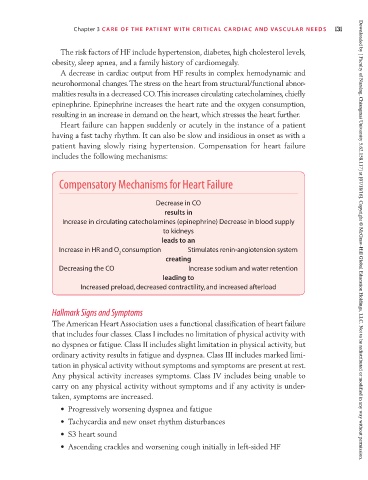
                               includes the following mechanisms:


                                 Compensatory Mechanisms for Heart Failure


                                                            Decrease in CO
                                                              results in
                                  Increase in circulating catecholamines (epinephrine) Decrease in blood supply
                                                              to kidneys
                                                             leads to an                                            Downloaded by [ Faculty of Nursing, Chiangmai University 5.62.158.117] at [07/18/16]. Copyright © McGraw-Hill Global Education Holdings, LLC. Not to be redistributed or modified in any way without permission.
                                 Increase in HR and O consumption    Stimulates renin-angiotension system
                                                 2
                                                              creating
                                 Decreasing the CO                   Increase sodium and water retention
                                                              leading to
                                       Increased preload, decreased contractility, and increased afterload


                               Hallmark Signs and Symptoms
                               The American Heart Association uses a functional classification of heart failure
                               that includes four classes. Class I includes no limitation of physical activity with
                               no dyspnea or fatigue. Class II includes slight limitation in physical activity, but
                               ordinary activity results in fatigue and dyspnea. Class III includes marked limi-
                               tation in physical activity without symptoms and symptoms are present at rest.
                               Any physical activity increases symptoms. Class IV includes being unable to
                               carry on any physical activity without symptoms and if any activity is under-
                               taken, symptoms are increased.
                                 •   Progressively worsening dyspnea and fatigue
                                 •   Tachycardia and new onset rhythm disturbances

                                 •   S3 heart sound
                                 •   Ascending crackles and worsening cough initially in left-sided HF

