


Page 233 - Critical Care Nursing Demystified
P. 233
218        CRITICAL CARE NURSING  DeMYSTIFIED


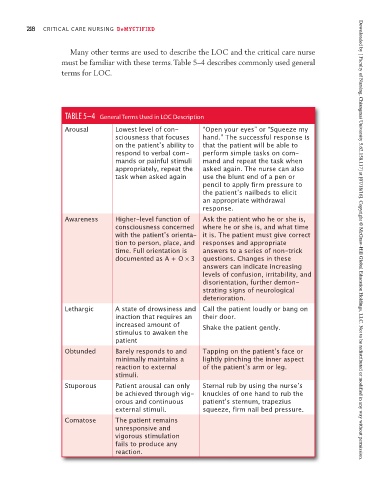
                               Many other terms are used to describe the LOC and the critical care nurse
                            must be familiar with these terms. Table 5–4 describes commonly used general
                            terms for LOC.


                             TABLE 5–4  General Terms Used in LOC Description
                             Arousal       Lowest level of con-     “Open your eyes” or “Squeeze my
                                           sciousness that focuses   hand.” The successful response is
                                           on the patientʼs ability to   that the patient will be able to
                                           respond to verbal com-   perform simple tasks on com-
                                           mands or painful stimuli   mand and repeat the task when
                                           appropriately, repeat the   asked again. The nurse can also
                                           task when asked again    use the blunt end of a pen or
                                                                    pencil to apply firm pressure to
                                                                    the patientʼs nailbeds to elicit
                                                                    an appropriate withdrawal
                                                                    response.
                             Awareness     Higher-level function of   Ask the patient who he or she is,
                                           consciousness concerned   where he or she is, and what time
                                           with the patientʼs orienta- it is. The patient must give correct
                                           tion to person, place, and  responses and appropriate                Downloaded by [ Faculty of Nursing, Chiangmai University 5.62.158.117] at [07/18/16]. Copyright © McGraw-Hill Global Education Holdings, LLC. Not to be redistributed or modified in any way without permission.
                                           time. Full orientation is   answers to a series of non-trick
                                           documented as A + O × 3  questions. Changes in these
                                                                    answers can indicate increasing
                                                                    levels of confusion, irritability, and
                                                                    disorientation, further demon-
                                                                    strating signs of neurological
                                                                    deterioration.
                             Lethargic     A state of drowsiness and  Call the patient loudly or bang on
                                           inaction that requires an   their door.
                                           increased amount of      Shake the patient gently.
                                           stimulus to awaken the
                                           patient
                             Obtunded      Barely responds to and   Tapping on the patientʼs face or
                                           minimally maintains a    lightly pinching the inner aspect
                                           reaction to external     of the patientʼs arm or leg.
                                             stimuli.
                             Stuporous     Patient arousal can only   Sternal rub by using the nurseʼs
                                           be achieved through vig-  knuckles of one hand to rub the
                                           orous and continuous     patientʼs sternum, trapezius
                                           external stimuli.        squeeze, firm nail bed pressure.
                             Comatose      The patient remains
                                           unresponsive and
                                           vigorous stimulation
                                           fails to produce any
                                           reaction.

