


Page 234 - Critical Care Nursing Demystified
P. 234
Chapter 5  CARE OF THE PATIENT WITH NEUROLOGICAL NEEDS        219


                                 Recounting a True Story

                                 As a Medical/Surgical Administrative Supervisor, I always made visiting rounds of my
                                 patients to determine their levels of care, safety, and satisfaction of care received. On
                                 report, I learned of a young, married man and father of two children who returned
                                 with his family to the area from Mississippi to visit his parents. On a hot and humid
                                 summer day, he frivolously and without looking dove backwards into his parents’
                                 empty swimming pool and sustained a serious head injury. Hospitalized, he was
                                 maintained on a general medical/surgical unit because according to staff members,
                                 he was oriented to person, place, and time. (A + O × 3.) His level of consciousness,
                                 vital signs, and motor and pupillary responses were all within normal limits. As I
                                 looked in on the patient, there was something about his “gaze,” that bothered me,
                                 so I decided to introduce myself and began to ask him the standard questions of his
                                 name, date, and current location. The patient seemed to be a tad agitated with my
                                 inquiries, so I ended it by asking him if he knew the name of the hospital he was in
                                 and he answered correctly. However, when I asked him where the hospital was lo-
                                 cated, he angrily replied, “Why in Mississippi of course!” Perhaps to a less seasoned
                                 nurse, this response could have been viewed as a small sign of a communication
                                 error. However, coupled with what I believed was an out-of-focus facial stare or gaze,
                                 I knew then that this patient’s neurological status was not up to par and perhaps   Downloaded by [ Faculty of Nursing, Chiangmai University 5.62.158.117] at [07/18/16]. Copyright © McGraw-Hill Global Education Holdings, LLC. Not to be redistributed or modified in any way without permission.
                                 deteriorating. He was immediately transferred to ICU for more in-depth care and
                                 observation. A subtle additional question by a concerned nurse probably saved this
                                 man’s life and provided interventions to prevent further neurologic disaster.


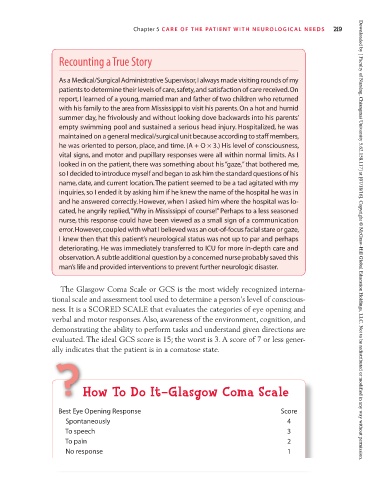
                                 The Glasgow Coma Scale or GCS is the most widely recognized interna-
                               tional scale and assessment tool used to determine a person’s level of conscious-
                               ness. It is a SCORED SCALE that evaluates the categories of eye opening and
                               verbal and motor responses. Also, awareness of the environment, cognition, and
                               demonstrating the ability to perform tasks and understand given directions are
                               evaluated. The ideal GCS score is 15; the worst is 3. A score of 7 or less gener-
                               ally indicates that the patient is in a comatose state.

                                       H ?  How To Do It—Glasgow Coma Scale


                                          o
                                                 o D
                                                       o I
                                                           t—Gl
                                            w T
                                                                   a
                                Best Eye Opening Response  ng Response                        Score
                                     y
                                      e Open
                                            i
                                Best E
                                  Spontaneous
                                  Spontaneously                                                 4
                                             ly
                                  To
                                   To speech eech                                               3

                                      p
                                     s
                                   o
                                  T
                                   To pain pain                                                 2
                                  No response onse                                              1
                                        p
                                     res
                                  No

