


Page 291 - Critical Care Nursing Demystified
P. 291
276        CRITICAL CARE NURSING  DeMYSTIFIED


                            therapy is initiated first and blood and colloids are considered if the response
                            of the heart rate, blood pressure, and baseline laboratory values do not improve.
                            Blood replacement is usually determined by changes in the patient’s hemoglo-
                            bin and hematocrit levels. Although resources vary, when the patient’s hemo-
                            globin drops to 8 g/dL and the patient has other associated symptoms like
                            unstable hemodynamic parameters, blood should be administered. Typically,
                            packed red blood cells or whole blood is given in the traumatized patient, with
                            whole blood being reserved for patients with coagulation problems like acute
                            gastrointestinal bleeding from esophageal varices.
                               In an emergency, massive transfusions may be needed. Massive transfusions
                            are defined as the total replacement of a patient’s blood volume in a 24-hour
                            period or half the patient’s estimated volume within an hour. Complications of
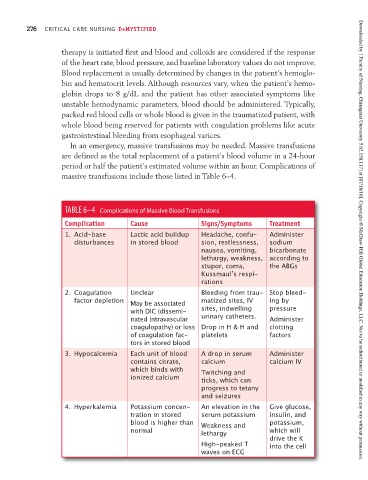
                            massive transfusions include those listed in Table 6–4.


                             TABLE 6–4  Complications of Massive Blood Transfusions
                             Complication       Cause              Signs/Symptoms     Treatment
                             1.  Acid-base      Lactic acid buildup   Headache, confu-  Administer
                                  disturbances  in stored blood    sion, restlessness,   sodium                 Downloaded by [ Faculty of Nursing, Chiangmai University 5.62.158.117] at [07/18/16]. Copyright © McGraw-Hill Global Education Holdings, LLC. Not to be redistributed or modified in any way without permission.
                                                                   nausea, vomiting,   bicarbonate
                                                                   lethargy, weakness,  according to
                                                                   stupor, coma,      the ABGs
                                                                   Kussmaulʼs respi-
                                                                   rations
                             2.  Coagulation    Unclear            Bleeding from trau- Stop bleed-
                                factor depletion  May be associated   matized sites, IV   ing by
                                                with DIC (dissemi-  sites, indwelling     pressure
                                                nated intravascular   urinary catheters.   Administer
                                                coagulopathy) or loss  Drop in H & H and   clotting
                                                of coagulation fac-  platelets          factors
                                                tors in stored blood
                             3.  Hypocalcemia   Each unit of blood   A drop in serum   Administer
                                                contains citrate,   calcium           calcium IV
                                                which binds with   Twitching and
                                                ionized calcium    ticks, which can
                                                                   progress to tetany
                                                                   and seizures
                             4. Hyperkalemia    Potassium concen-  An elevation in the   Give glucose,
                                                tration in stored   serum potassium   insulin, and
                                                blood is higher than   Weakness and   potassium,
                                                normal               lethargy         which will
                                                                                      drive the K
                                                                   High-peaked T      into the cell
                                                                   waves on ECG

