


Page 390 - Critical Care Nursing Demystified
P. 390
Chapter 8  CARE OF THE PATIENT WITH CRITICAL RENAL NEEDS        375


                                                   Veins  Radial artery
                                                 (blood to  (blood from
                                                 the heart)  the heart)
                                                                        AV fistula


                                                                           to dialyzer

                                                                         from dialyzer

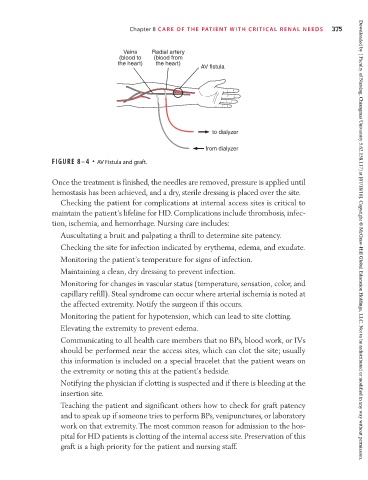
                               FIGURE 8–4  •  AV Fistula and graft.

                               Once the treatment is finished, the needles are removed, pressure is applied until
                               hemostasis has been achieved, and a dry, sterile dressing is placed over the site.
                                 Checking the patient for complications at internal access sites is critical to
                               maintain the patient’s lifeline for HD. Complications include thrombosis, infec-
                               tion, ischemia, and hemorrhage. Nursing care includes:
                                 Auscultating a bruit and palpating a thrill to determine site patency.             Downloaded by [ Faculty of Nursing, Chiangmai University 5.62.158.117] at [07/18/16]. Copyright © McGraw-Hill Global Education Holdings, LLC. Not to be redistributed or modified in any way without permission.
                                 Checking the site for infection indicated by erythema, edema, and exudate.
                                 Monitoring the patient’s temperature for signs of infection.
                                 Maintaining a clean, dry dressing to prevent infection.
                                 Monitoring for changes in vascular status (temperature, sensation, color, and
                                 capillary refill). Steal syndrome can occur where arterial ischemia is noted at
                                 the affected extremity. Notify the surgeon if this occurs.
                                 Monitoring the patient for hypotension, which can lead to site clotting.
                                 Elevating the extremity to prevent edema.
                                 Communicating to all health care members that no BPs, blood work, or IVs
                                 should be performed near the access sites, which can clot the site; usually
                                 this information is included on a special bracelet that the patient wears on
                                 the extremity or noting this at the patient’s bedside.
                                 Notifying the physician if clotting is suspected and if there is bleeding at the
                                 insertion site.
                                 Teaching the patient and significant others how to check for graft patency
                                 and to speak up if someone tries to perform BPs, venipunctures, or laboratory
                                 work on that extremity. The most common reason for admission to the hos-
                                 pital for HD patients is clotting of the internal access site. Preservation of this
                                 graft is a high priority for the patient and nursing staff.

