


Page 386 - Critical Care Nursing Demystified
P. 386
Chapter 8  CARE OF THE PATIENT WITH CRITICAL RENAL NEEDS        371


                               TABLE 8–3  Miscellaneous Medications Used With Patients in ARF and CRF (Continued)
                               Medication      Actions         Use              Precautions
                               Water-soluble   Needed for      CRF              1.  Monitor the response
                               vitamins like   cellular growth                    to the drugs like
                               B, C            and repair                         alleviation of anemia
                                               Important in                     2.  Must be given after
                                               RBC formation                      dialysis or they are
                                                                                  removed during
                                                                                  dialysis treatment
                                                                                3.  Observe for hyper-
                                                                                  sensitivity


                       Dialysis

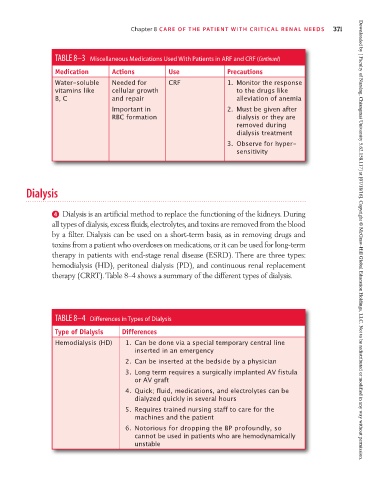
                               4   Dialysis is an artificial method to replace the functioning of the kidneys. During
                               all types of dialysis, excess fluids, electrolytes, and toxins are removed from the blood
                               by a filter. Dialysis can be used on a short-term basis, as in removing drugs and
                               toxins from a patient who overdoses on medications, or it can be used for long-term   Downloaded by [ Faculty of Nursing, Chiangmai University 5.62.158.117] at [07/18/16]. Copyright © McGraw-Hill Global Education Holdings, LLC. Not to be redistributed or modified in any way without permission.
                               therapy in patients with end-stage renal disease (ESRD). There are three types:
                               hemodialysis (HD), peritoneal dialysis (PD), and continuous renal replacement
                               therapy (CRRT). Table 8–4 shows a summary of the different types of dialysis.


                               TABLE 8–4  Differences in Types of Dialysis
                               Type of Dialysis   Differences
                               Hemodialysis (HD)   1.  Can be done via a special temporary central line
                                                      inserted in an emergency
                                                   2.  Can be inserted at the bedside by a physician
                                                   3.  Long term requires a surgically implanted AV fistula
                                                      or AV graft
                                                   4.  Quick; fluid, medications, and electrolytes can be
                                                      dialyzed quickly in several hours
                                                   5.  Requires trained nursing staff to care for the
                                                      machines and the patient
                                                   6.  Notorious for dropping the BP profoundly, so
                                                      cannot be used in patients who are hemodynamically
                                                      unstable

