


Page 387 - Critical Care Nursing Demystified
P. 387
372        CRITICAL CARE NURSING  DeMYSTIFIED


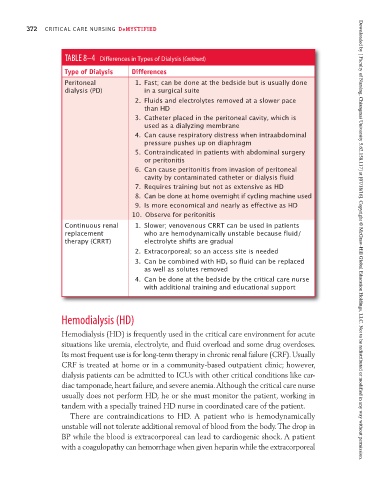
                             TABLE 8–4  Differences in Types of Dialysis (Continued)
                             Type of Dialysis   Differences
                             Peritoneal          1.  Fast; can be done at the bedside but is usually done
                             dialysis (PD)         in a surgical suite
                                                 2.  Fluids and electrolytes removed at a slower pace
                                                   than HD
                                                 3.  Catheter placed in the peritoneal cavity, which is
                                                   used as a dialyzing membrane
                                                 4.  Can cause respiratory distress when intraabdominal
                                                   pressure pushes up on diaphragm
                                                 5.  Contraindicated in patients with abdominal surgery
                                                   or peritonitis
                                                 6.  Can cause peritonitis from invasion of peritoneal
                                                   cavity by contaminated catheter or dialysis fluid
                                                 7.  Requires training but not as extensive as HD
                                                 8.  Can be done at home overnight if cycling machine used
                                                 9.  Is more economical and nearly as effective as HD
                                                10.  Observe for peritonitis
                             Continuous renal    1.  Slower; venovenous CRRT can be used in patients
                             replacement           who are hemodynamically unstable because fluid/
                             therapy (CRRT)        electrolyte shifts are gradual                               Downloaded by [ Faculty of Nursing, Chiangmai University 5.62.158.117] at [07/18/16]. Copyright © McGraw-Hill Global Education Holdings, LLC. Not to be redistributed or modified in any way without permission.
                                                 2.  Extracorporeal; so an access site is needed
                                                 3.  Can be combined with HD, so fluid can be replaced
                                                   as well as solutes removed
                                                 4.  Can be done at the bedside by the critical care nurse
                                                   with additional training and educational support


                            Hemodialysis (HD)
                            Hemodialysis (HD) is frequently used in the critical care environment for acute
                            situations like uremia, electrolyte, and fluid overload and some drug overdoses.
                            Its most frequent use is for long-term therapy in chronic renal failure (CRF). Usually
                            CRF is treated at home or in a community-based outpatient clinic; however,
                            dialysis patients can be admitted to ICUs with other critical conditions like car-
                            diac tamponade, heart failure, and severe anemia. Although the critical care nurse
                            usually does not perform HD, he or she must monitor the patient, working in
                            tandem with a specially trained HD nurse in coordinated care of the patient.
                               There are contraindications to HD. A patient who is hemodynamically
                            unstable will not tolerate additional removal of blood from the body. The drop in
                            BP while the blood is extracorporeal can lead to cardiogenic shock. A patient
                            with a coagulopathy can hemorrhage when given heparin while the extracorporeal

