


Page 389 - Critical Care Nursing Demystified
P. 389
374        CRITICAL CARE NURSING  DeMYSTIFIED


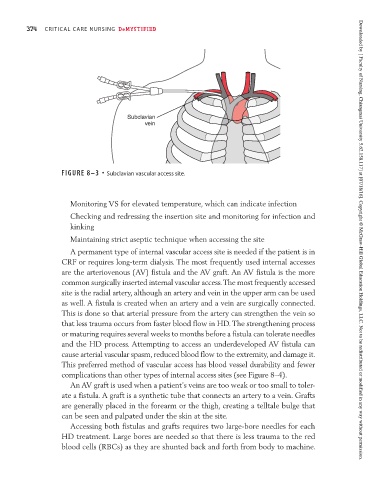
                                               Subclavian
                                                    vein


                            FIGURE 8–3  •  Subclavian vascular access site.


                               Monitoring VS for elevated temperature, which can indicate infection
                               Checking and redressing the insertion site and monitoring for infection and
                               kinking
                               Maintaining strict aseptic technique when accessing the site                     Downloaded by [ Faculty of Nursing, Chiangmai University 5.62.158.117] at [07/18/16]. Copyright © McGraw-Hill Global Education Holdings, LLC. Not to be redistributed or modified in any way without permission.
                               A permanent type of internal vascular access site is needed if the patient is in
                            CRF or requires long-term dialysis. The most frequently used internal accesses
                            are the arteriovenous (AV) fistula and the AV graft. An AV fistula is the more
                            common surgically inserted internal vascular access. The most frequently accessed
                            site is the radial artery, although an artery and vein in the upper arm can be used
                            as well. A fistula is created when an artery and a vein are surgically connected.
                            This is done so that arterial pressure from the artery can strengthen the vein so
                            that less trauma occurs from faster blood flow in HD. The strengthening process
                            or maturing requires several weeks to months before a fistula can tolerate needles
                            and the HD process. Attempting to access an underdeveloped AV fistula can
                            cause arterial vascular spasm, reduced blood flow to the extremity, and damage it.
                            This preferred method of vascular access has blood vessel durability and fewer
                            complications than other types of internal access sites (see Figure 8–4).
                               An AV graft is used when a patient’s veins are too weak or too small to toler-
                            ate a fistula. A graft is a synthetic tube that connects an artery to a vein. Grafts
                            are generally placed in the forearm or the thigh, creating a telltale bulge that
                            can be seen and palpated under the skin at the site.
                               Accessing both fistulas and grafts requires two large-bore needles for each
                            HD treatment. Large bores are needed so that there is less trauma to the red
                            blood cells (RBCs) as they are shunted back and forth from body to machine.

