


Page 396 - Critical Care Nursing Demystified
P. 396
Chapter 8  CARE OF THE PATIENT WITH CRITICAL RENAL NEEDS        381


                               Like PD, CRRT uses the principles of diffusion and osmosis to remove fluid and
                               waste products from the patient’s system. Unlike HD and PD, it is much slower
                               and is administered over a longer period of time. Because body changes occur
                               at a much slower rate, CRRT can be used if the patient is hemodynamically
                               unstable, making it a clear choice in many shocky patients. It can be done over
                               24 hours until the patient is stabilized and can tolerate other forms of dialysis
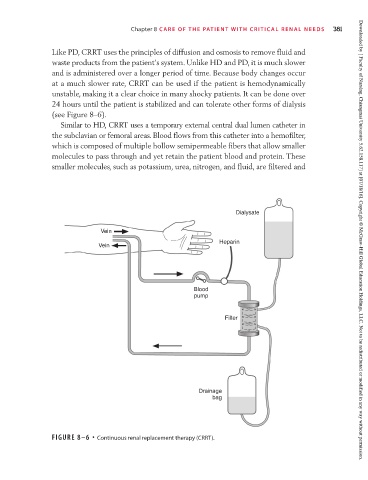
                               (see Figure 8–6).
                                 Similar to HD, CRRT uses a temporary external central dual lumen catheter in
                               the subclavian or femoral areas. Blood flows from this catheter into a hemofilter,
                               which is composed of multiple hollow semipermeable fibers that allow smaller
                               molecules to pass through and yet retain the patient blood and protein. These
                               smaller molecules, such as potassium, urea, nitrogen, and fluid, are filtered and


                                                                                  Dialysate


                                            Vein
                                                                             Heparin                                Downloaded by [ Faculty of Nursing, Chiangmai University 5.62.158.117] at [07/18/16]. Copyright © McGraw-Hill Global Education Holdings, LLC. Not to be redistributed or modified in any way without permission.
                                            Vein


                                                                      Blood
                                                                      pump


                                                                               Filter


                                                                        Drainage
                                                                           bag


                               FIGURE 8–6  •  Continuous renal replacement therapy (CRRT).

