


Page 399 - Critical Care Nursing Demystified
P. 399
384        CRITICAL CARE NURSING  DeMYSTIFIED


                            necrosis (ATN). ATN occurs when destruction of tubular epithelial cells results
                            in increased intraluminal pressure, which greatly reduces GFR and renal func-
                            tion. Direct damage of the nephrons or cortex results in tubular swelling
                            and then necrosis, thus the title ATN. Debris from swelling and necrosis leads
                            to blocking blood and filtrate flow further leads to stasis of urine and more
                            necrosis.
                               Other causes of intrarenal failure include acute glomerulonephritis, nephro-
                            toxic drugs (contrast dye, aminoglycoside antibiotics) and ischemia.
                               Postrenal failure is basically obstructive in nature. Obstructions can occur
                            anywhere in the kidney or the ducts and organs that drain to the urethra.
                            Abnormalities like kidney stones or tumors can lead to backup of urine and
                            stasis leading to dilation of the system, increased GFR, and increased edema
                            from water and sodium reabsorption and infection.
                               No matter where the renal failure occurs, the end result of this insult will
                            lead to retention of wastes, chiefly nitrogen and electrolytes, and metabolic
                            acidosis, which can lead to organ failure.


                              NURSING ALERT                                                                     Downloaded by [ Faculty of Nursing, Chiangmai University 5.62.158.117] at [07/18/16]. Copyright © McGraw-Hill Global Education Holdings, LLC. Not to be redistributed or modified in any way without permission.

                              A large amount of radiographic dye is injected during arteriograms of many organs
                              like the heart, brain, and kidney. ATN from intrarenal failure can start 48 hours after
                              drug administration and peak in 3 days. If the patient is discharged earlier than these
                              times, nursing teaching at discharge regarding signs/symptoms of ATN is imperative
                              to preserve kidney functioning.


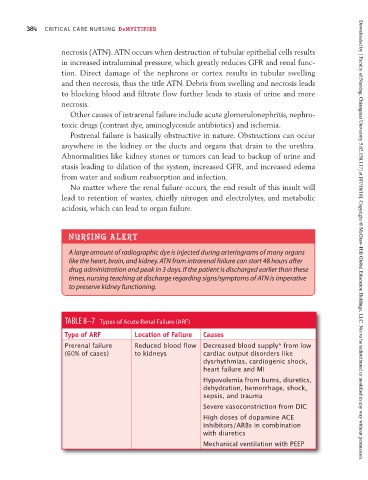
                             TABLE 8–7  Types of Acute Renal Failure (ARF)

                             Type of ARF         Location of Failure  Causes
                             Prerenal failure    Reduced blood flow  Decreased blood supply* from low
                             (60% of cases)      to kidneys         cardiac output disorders like
                                                                    dysrhythmias, cardiogenic shock,
                                                                    heart failure and MI
                                                                    Hypovolemia from burns, diuretics,
                                                                    dehydration, hemorrhage, shock,
                                                                    sepsis, and trauma
                                                                    Severe vasoconstriction from DIC
                                                                    High doses of dopamine ACE
                                                                    inhibitors/ARBs in combination
                                                                    with diuretics
                                                                    Mechanical ventilation with PEEP

