


Page 397 - Critical Care Nursing Demystified
P. 397
382        CRITICAL CARE NURSING  DeMYSTIFIED


                            removed from the body into a drainage bag. The bag is drained according to
                            institutional protocols, not unlike PD, and a tally is kept of how much fluid the
                            CRRT has removed from the patient.
                               There are several different types of CCRT that are distinguished by the sol-
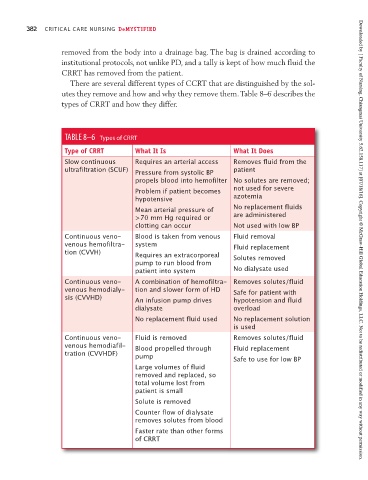
                            utes they remove and how and why they remove them. Table 8–6 describes the
                            types of CRRT and how they differ.


                             TABLE 8–6  Types of CRRT

                             Type of CRRT        What It Is                 What It Does
                             Slow continuous     Requires an arterial access   Removes fluid from the
                             ultrafiltration (SCUF)  Pressure from systolic BP   patient
                                                 propels blood into hemofilter  No solutes are removed;
                                                 Problem if patient becomes   not used for severe
                                                 hypotensive                azotemia
                                                 Mean arterial pressure of   No replacement fluids
                                                 >70 mm Hg required or      are administered
                                                 clotting can occur         Not used with low BP
                             Continuous veno-    Blood is taken from venous   Fluid removal
                             venous hemofiltra-  system                     Fluid replacement                   Downloaded by [ Faculty of Nursing, Chiangmai University 5.62.158.117] at [07/18/16]. Copyright © McGraw-Hill Global Education Holdings, LLC. Not to be redistributed or modified in any way without permission.
                             tion (CVVH)         Requires an extracorporeal
                                                 pump to run blood from     Solutes removed
                                                 patient into system        No dialysate used
                             Continuous veno-    A combination of hemofiltra- Removes solutes/fluid
                             venous hemodialy-   tion and slower form of HD   Safe for patient with
                             sis (CVVHD)         An infusion pump drives    hypotension and fluid
                                                 dialysate                  overload
                                                 No replacement fluid used  No replacement solution
                                                                            is used
                             Continuous veno-    Fluid is removed           Removes solutes/fluid
                             venous hemodiafil-  Blood propelled through    Fluid replacement
                             tration (CVVHDF)
                                                 pump                       Safe to use for low BP
                                                 Large volumes of fluid
                                                 removed and replaced, so
                                                 total volume lost from
                                                 patient is small
                                                 Solute is removed
                                                 Counter flow of dialysate
                                                 removes solutes from blood
                                                 Faster rate than other forms
                                                 of CRRT

