


Page 403 - Critical Care Nursing Demystified
P. 403
388        CRITICAL CARE NURSING  DeMYSTIFIED


                            Chronic Renal Failure (CRF)

                            What Went Wrong?
                             5   Chronic renal failure (CRF) is a progressively worsening, irreversible loss of
                            kidney function. Although CRF is irreversible, it can be slowed by medications
                            and diet. In CRF, the kidneys lose their ability to maintain homeostasis with
                            fluid balance and waste accumulation leading to end-stage renal disease (ESRD)
                            and the need for dialysis. CRF is identified by glomerular filtration rate (GFR)
                            and is divided into three stages: reduced renal reserve, renal insufficiency, and
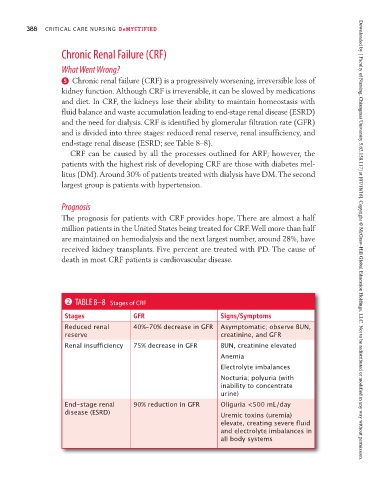
                            end-stage renal disease (ESRD; see Table 8–8).
                               CRF can be caused by all the processes outlined for ARF; however, the
                            patients with the highest risk of developing CRF are those with diabetes mel-
                            litus (DM). Around 30% of patients treated with dialysis have DM. The second
                            largest group is patients with hypertension.


                            Prognosis
                            The prognosis for patients with CRF provides hope. There are almost a half
                            million patients in the United States being treated for CRF. Well more than half
                            are maintained on hemodialysis and the next largest number, around 28%, have        Downloaded by [ Faculty of Nursing, Chiangmai University 5.62.158.117] at [07/18/16]. Copyright © McGraw-Hill Global Education Holdings, LLC. Not to be redistributed or modified in any way without permission.
                            received kidney transplants. Five percent are treated with PD. The cause of
                            death in most CRF patients is cardiovascular disease.


                              2   TABLE 8–8  Stages of CRF
                             Stages             GFR                      Signs/Symptoms
                             Reduced renal      40%–70% decrease in GFR  Asymptomatic; observe BUN,
                             reserve                                     creatinine, and GFR
                             Renal insufficiency  75% decrease in GFR    BUN, creatinine elevated
                                                                         Anemia
                                                                         Electrolyte imbalances
                                                                         Nocturia; polyuria (with
                                                                         inability to concentrate
                                                                         urine)
                             End-stage renal    90% reduction in GFR     Oliguria <500 mL/day
                             disease (ESRD)
                                                                         Uremic toxins (uremia)
                                                                         elevate, creating severe fluid
                                                                         and electrolyte imbalances in
                                                                         all body systems

