


Page 438 - Critical Care Nursing Demystified
P. 438
Chapter 9  CARE OF THE PATIENT WITH CRITICAL HEMATOLOGIC NEEDS        423


                                 Initiate drotrecogin alfa (Xigris) therapy for patients with severe sepsis and
                                 MOSD.
                                 Use strict aseptic technique when performing invasive procedures to decrease
                                 introduction of pathogens.
                                 Introduce nutritional support early to help with repair and replacement of
                                 injured cells.
                                 Institute deep vein thrombosis prophylaxis, which includes turning, anti-
                                 thrombic stockings, sequential inflation stockings, and low molecular weight
                                 heparin to prevent blood clots and pulmonary emboli.
                                 Provide emotional support to patient and significant others as this is a highly
                                 fatal situation.


                               Disseminated Intravascular Coagulopathy (DIC)
                               What Went Wrong?
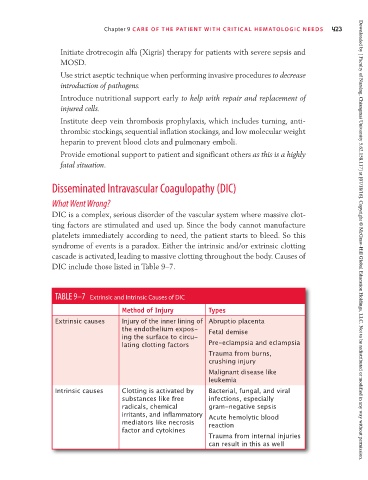
                               DIC is a complex, serious disorder of the vascular system where massive clot-
                               ting factors are stimulated and used up. Since the body cannot manufacture
                               platelets immediately according to need, the patient starts to bleed. So this
                               syndrome of events is a paradox. Either the intrinsic and/or extrinsic clotting      Downloaded by [ Faculty of Nursing, Chiangmai University 5.62.158.117] at [07/18/16]. Copyright © McGraw-Hill Global Education Holdings, LLC. Not to be redistributed or modified in any way without permission.
                               cascade is activated, leading to massive clotting throughout the body. Causes of
                               DIC include those listed in Table 9–7.


                               TABLE 9–7  Extrinsic and Intrinsic Causes of DIC
                                                  Method of Injury        Types
                               Extrinsic causes   Injury of the inner lining of  Abruptio placenta
                                                  the endothelium expos-  Fetal demise
                                                  ing the surface to circu-
                                                  lating clotting factors  Pre-eclampsia and eclampsia
                                                                          Trauma from burns,
                                                                          crushing injury
                                                                          Malignant disease like
                                                                          leukemia
                               Intrinsic causes   Clotting is activated by   Bacterial, fungal, and viral
                                                  substances like free    infections, especially
                                                  radicals, chemical      gram-negative sepsis
                                                  irritants, and inflammatory   Acute hemolytic blood
                                                  mediators like necrosis   reaction
                                                  factor and cytokines
                                                                          Trauma from internal injuries
                                                                          can result in this as well

