


Page 439 - Critical Care Nursing Demystified
P. 439
424        CRITICAL CARE NURSING  DeMYSTIFIED


                               Regardless of cause, the end result is the same: massive use of clotting activa-
                            tion and clotting factors cannot be replaced quickly enough by the liver and bone
                            marrow. This ultimately leads to bleeding and possible hemorrhagic shock.
                               Tissue hypoxia also results as clots formed in smaller capillaries and blood
                            vessels prevent delivery of nutrients to the cells and organs.
                               DIC can be recognized by three basic abnormalities that occur:

                               1.  Massive clotting resulting in organ damage from tissue hypoxia
                               2.  Accelerated production of natural anticoagulants
                               3.  Splitting apart of existing clots

                            Prognosis
                            DIC carries a high mortality rate, especially in the elderly and in patients with
                            coexisting medical problems.

                            Interpreting Laboratory/Diagnostic Results
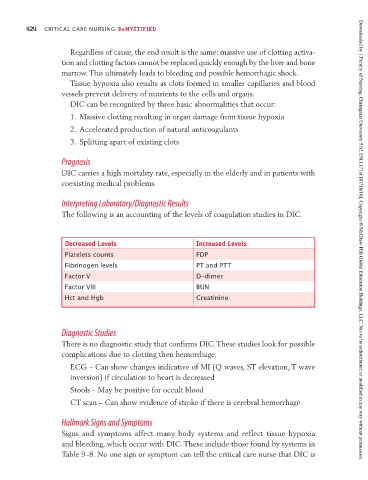
                            The following is an accounting of the levels of coagulation studies in DIC.


                             Decreased Levels                     Increased Levels                              Downloaded by [ Faculty of Nursing, Chiangmai University 5.62.158.117] at [07/18/16]. Copyright © McGraw-Hill Global Education Holdings, LLC. Not to be redistributed or modified in any way without permission.
                             Platelets counts                     FDP
                             Fibrinogen levels                    PT and PTT
                             Factor V                             D-dimer
                             Factor VIII                          BUN
                             Hct and Hgb                          Creatinine


                            Diagnostic Studies
                            There is no diagnostic study that confirms DIC. These studies look for possible
                            complications due to clotting then hemorrhage.
                               ECG – Can show changes indicative of MI (Q waves, ST elevation, T wave
                               inversion) if circulation to heart is decreased
                               Stools – May be positive for occult blood
                               CT scan – Can show evidence of stroke if there is cerebral hemorrhage


                            Hallmark Signs and Symptoms
                            Signs and symptoms affect many body systems and reflect tissue hypoxia
                            and bleeding, which occur with DIC. These include those found by systems in
                            Table 9–8. No one sign or symptom can tell the critical care nurse that DIC is

