


Page 434 - Critical Care Nursing Demystified
P. 434
Chapter 9  CARE OF THE PATIENT WITH CRITICAL HEMATOLOGIC NEEDS        419


                               septic shock. Vasoactive substances like histamine, tumor necrosis factor, and
                               interleukins increase vasodilatation by increasing capillary permeability. Overall
                               this decreases systemic vascular resistance (SVR), which is seen in a dropped
                               BP and CO.


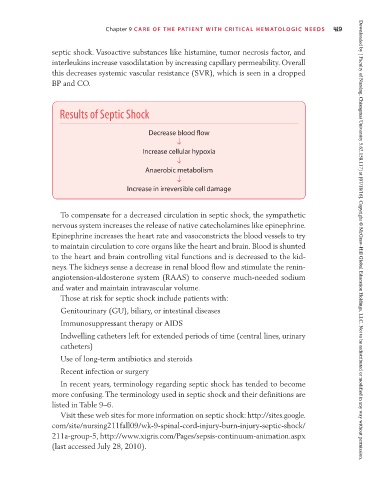
                                 Results of Septic Shock

                                                          Decrease blood flow
                                                                 ↓
                                                        Increase cellular hypoxia
                                                                 ↓
                                                         Anaerobic metabolism
                                                                 ↓
                                                    Increase in irreversible cell damage


                                 To compensate for a decreased circulation in septic shock, the sympathetic
                               nervous system increases the release of native catecholamines like epinephrine.
                               Epinephrine increases the heart rate and vasoconstricts the blood vessels to try
                               to maintain circulation to core organs like the heart and brain. Blood is shunted    Downloaded by [ Faculty of Nursing, Chiangmai University 5.62.158.117] at [07/18/16]. Copyright © McGraw-Hill Global Education Holdings, LLC. Not to be redistributed or modified in any way without permission.
                               to the heart and brain controlling vital functions and is decreased to the kid-
                               neys. The kidneys sense a decrease in renal blood flow and stimulate the renin-
                               angiotension-aldosterone system (RAAS) to conserve much-needed sodium
                               and water and maintain intravascular volume.
                                 Those at risk for septic shock include patients with:
                                 Genitourinary (GU), biliary, or intestinal diseases
                                 Immunosuppressant therapy or AIDS

                                 Indwelling catheters left for extended periods of time (central lines, urinary
                                 catheters)
                                 Use of long-term antibiotics and steroids
                                 Recent infection or surgery
                                 In recent years, terminology regarding septic shock has tended to become
                               more confusing. The terminology used in septic shock and their definitions are
                               listed in Table 9–6.
                                 Visit these web sites for more information on septic shock: http://sites.google.
                               com/site/nursing211fall09/wk-9-spinal-cord-injury-burn-injury-septic-shock/
                               211a-group-5, http://www.xigris.com/Pages/sepsis-continuum-animation.aspx
                               (last accessed July 28, 2010).

